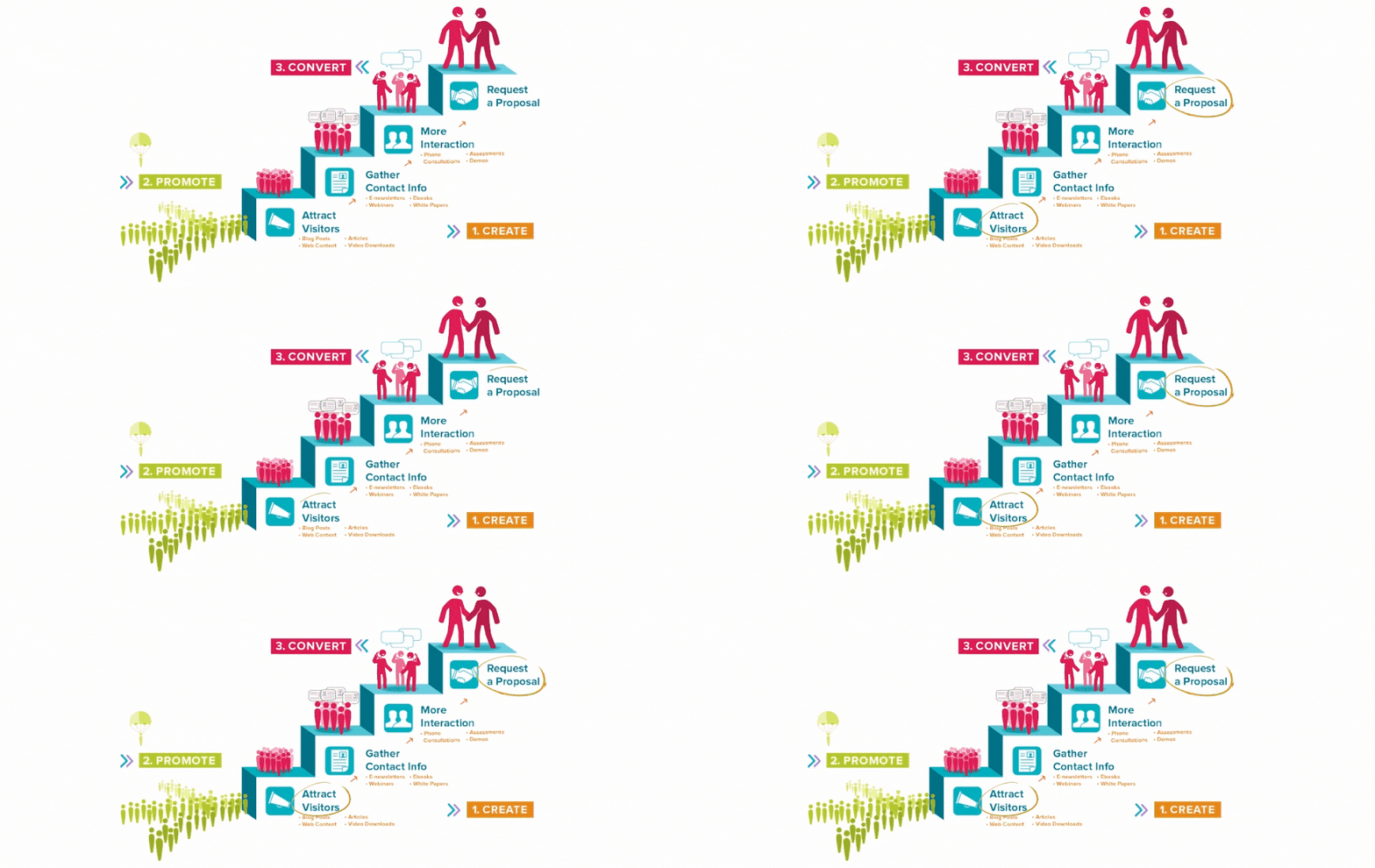


Storytelling in Content Marketing: Why It Still Matters in 2026

Nowadays, there is a myth in content marketing that, storytelling era is over.The storytelling era in content marketing is over. You hear all the reasons repeatedly. Audiences now have too many distractions, attention spans are shorter than ever, and AI has the ability to create content faster than a human could ever write.
The popular thought behind these points is that there is no longer a need for storytelling. Instead, people want answers, plain and simple.
However, within this same time frame, year after year, and despite all the noise, the brands that understand the art of storytelling continue to grow. They do so, not because they’ve been able to ignore the noise, but because they consistently have something real to say, and have consistently said those things in ways that have meaning to others.
People are primarily unchanged and continue to seek connection. Therefore, they still want to identify meaning and connection in what they’re reading. Brands that present themselves as human rather than efficient will continue to receive audience trust and loyalty.
These are not just trends, but they are constants that will remain moving forward.
In 2026, storytelling in content marketing will be more than just a thing of the past. It will define the new edge of business success. Companies that embrace the art of storytelling will build returning audiences, rather than simply visitors who come and go.
This blog article discusses how storytelling is evolving and why the current environment will allow companies that embrace it to leverage the art of storytelling better than ever.

✅ The Problem With Most Content Today
Most content marketing is pretty bad. Most brands publish blog posts that answer questions that no one asked. Write social media posts that sound like a press release. And produce newsletters that feel more like product catalogues than anything else. None of this content is necessarily wrong, but it is definitely unmemorable.
When you look at the difference between informing your audience and creating resonance, learning is strictly telling people something, while storytelling is making people feel something. And what people feel is what they remember.
So, when we look at the brands that will set the standard for content marketing in 2026, it won’t be those brands that produce the most content, but rather the brands that produce the most memorable content.
Memorable content contains a point of view. It comes from a person. It provides information and an answer to a question, but it also provides insight to your audience that will make them think of you because they feel as if you care enough to have thought about them when you wrote it.
This is exactly what happens through storytelling, and this is why storytelling will always be relevant.
✅ What Storytelling in Content Marketing Actually Means
When many people hear “storytelling”, they think of long prose stories with a hero’s journey. They also think of traditional three-segment plot structures with a beginning, middle and end.
But there is another way to define storytelling in the context of content marketing. Storytelling, as it relates to your content, is much easier than that and also broader!
A story is just about any piece of content that contains a truth about humans (human truth). A case study that illustrates you rooting for your clients. A LinkedIn post that begins with a mistake and concludes with a lesson. A blog post that begins with a circumstance that is familiar to the reader from their job.
It doesn’t matter the length. It doesn’t matter the drama. It doesn’t matter the relevance.
When someone reads your content and has the thought, “That’s exactly how I feel”, that is storytelling working! When the person sends your newsletter to their colleague with the message, “You must read this!”, you are employing storytelling! Format changes. Platform changes. Principles don’t!
✅ Why AI Makes Storytelling More Important, Not Less
In 2026, award-winning storytelling will be worth its weight in gold because we now have so much AI-generated content that audiences value what a human can create more than any algorithm could ever replicate.
The reason is fairly simple. AI can generate massive amounts of content, answer thousands of questions, and achieve the highest possible SEO score through its use of autonomous behaviour. However, it lacks the human touch required to create unique, tailored, and story-driven experiences for brands.
The unique data points from your individual customers’ success stories, the originality of your team’s experience in finding solutions to complex problems, and the wisdom you have gained from your entire career (even when it ultimately led to a painful lesson) are irreplaceable pieces of content marketing.
All of these examples serve as distinct pieces of content that will continue to rise in value as the floodgates open and create a sea of AI-generated content that has no identifiable differentiating factors. It becomes increasingly difficult not to create duplicates.
Brands that invest time and energy into building their content marketing strategies around a single core idea. ‘Specificity’, will ultimately win the content marketing game in 2026.
True to the definition, brands that use specific facts (real names, real numbers, specific situations) will have a better chance of breaking through the noise than brands that only deliver generalised messages regarding ‘helping businesses grow.’
AI will be able to generate words in relation to a subject matter, but only with the help of humans will it be able to create stories out of the content.
✅ The Science Behind Why Stories Work
These neurological phenomena are not simply creative reasoning. There are active neurological processes involved when we read factual lists, as compared to when we read stories. For example, when we read facts, our brains process and move on. However, when we read a story, multiple regions in our brains are activated. For example, areas associated with emotion, movement or sensing an experience. We are not merely processing, we are participating as well.
This process is called “Neural Coupling”, and it is why we retain stories for a longer period of time than we do statistics. Thus, if a potential customer reads a case study about how your agency helped someone similar to them, they will be able to recall your agency 3 months later. whereas potential customers who only read your services page will most likely not be able to recall you.
Trust is another component of storytelling that can also create authenticity when done correctly. Storytelling demonstrates that you are more than just a voice broadcasting your message. You have provided an opportunity for the construction of relationships through shared experiences with others. As a result, storytellers have demonstrated low-pressure engagement, which is an essential component in attaining high-trust relationships.
In the realm of content marketing, trust is the one commodity that accumulates interest. Every genuine story told will accumulate “interest”, while every generic, unoptimised, untrustworthy piece will detract “interest” from trust capital.

✅ What Good Storytelling Looks Like in Practice
Let’s be practical about it, and how easy it is to agree on the concept of storytelling but very difficult to put into practice.
In 2026, different types of content will look like this:
📌 Blog Posts: The scenario, instead of the definition, when you’re writing. “Content marketing is about creating valuable content …” may sound like a great start. But what if you say, “Last month, a CMO told us that she had written 40 blog posts and did not see any measurable traffic growth over the year. How could we not help ease her?” This still talks about the same topic. But it opens differently for numerous readers. One will read the entire article, and the other may not even finish reading the first sentence.
📌 Case Studies: Case studies are not before or after photos. The transformation is not your story. The struggle is. What did the customer fear? What went wrong? What did they have to do internally to achieve results? Those elements provide credibility to your case studies, and credibility equals shareable content.
📌 Social networks: The content that goes viral on LinkedIn in 2026 is not the one that is simply polished. They start with something awkward. They begin with a failure to achieve a goal. They consist of an unusual, unexpected thought. They pose a question that few will say out loud in their industries. One honest statement is far more impactful than five neatly formatted bulleted items.
📌 Email newsletters: Write for one person as opposed to a list. Think through who you are specifically trying to reach. Their profession, what they are most frustrated with, & what they slipped or failed to find for you. Then write each newsletter as if you were answering their individual email. Newsletters with the highest open rates are those that feel personal, though they may be sent in mass.
📌 Video: The first three seconds are the most important part of your video. Not the logo, not the animated intro, nor the manufactured. “Today, we’re going to discuss…”. Start with the conflict; start with the question; start with the perceived need for the viewer to hear or see: “I need to see the rest of this.”
✅ The Brand Voice Question
Telling stories can only work if they are told in your own voice, and your voice must be clear enough for your audience to understand you in order to connect with them as well as build trust with you through their experience with your brand’s message over time.
Many companies attempt to project who they are through a combination of standard phrases or clear definitions. However, when these companies do so, their messages tend to appear generic and therefore lacking in an identity. Thus, making them indistinguishable from other companies.
Your brand’s voice has the ability to act as a storyteller’s narrator behind each piece of content created about your products/services. Without clarity around your brand’s voice, your company’s story is likely to become convoluted or blurred.
Companies that have done this successfully in 2026 have made a definitive choice in selecting how they wish to be portrayed in communications. They have established an overall point of view that is consistently communicated across all content they produce, whether the message is conveyed through an online blog article, a LinkedIn comment, or a product description.
Consistency in communication, therefore does not mean using the same adjectives repeatedly within each post you produce. But rather being consistent with your use of Word choice based on your business’s mission statement. This level of clarity creates a sense of familiarity amongst communicators as it shows everyone that they understand who the business is while not compromising on what they represent or stand for.
Each time clarity is created with each piece of communication it creates greater success for a company as it lays a strong foundation for a long-term relationship that builds trust between customers and companies.
✅ Measuring Storytelling: What to Track
Storytelling is one area where many marketers tend to avoid using because they feel there is no way to measure their success. Indeed, there really isn’t a way to A/B test the emotional impact of a story in the same way you can A/B test a subject line. However, there are many indicators you can track that tell you if your story is working.
One of those indicators is time-on-page. If a reader spends ten or fifteen minutes reading a blog post, then that reader was engaged with that particular story. If the reader only spends three or four seconds reading a blog post. It is likely that the story did not engage them.
Another signal is the number of social shares a story gets. People do not typically share information they have found useful. They share information after they have had a feeling and would like to share that same feeling with the people within their network.
The most powerful forms of engagement are replies, comments, and direct messages. When someone takes the time to send you a reply via email, it means you created a conversation through the story. The conversation can lead to developing an ongoing relationship with that reader.
Return visitors are an important indicator. When a person returns to your blog, they have developed some trust in you, and as you pass through the content marketing journey, trust becomes your key indicator of everything else.
✅ The Long Game
The reality of storytelling as content marketing will not happen immediately. A good story alone will not build your customer base overnight. In fact, one good story does nothing but add to creating your customer base (one at a time).
It is building something; building an audience who knows and cares about you, piece by piece, story by story.
In a world where most companies are focused on driving traffic now and want the immediate payback of hitting their KPI with viral content, it is those brands that are committed to continuing the practice of real storytelling over time that end up being in a category of their own.
They are not just another digital marketing agency, SaaS company or consulting firm. They are the company with the good newsletter, the blog that people forward to others in Slack and the company whose content gets potential customers feeling like they know and trust the people in the company prior to speaking with any of their salespeople.
That kind of brand equity is earned, not purchased, one honest, well-told story at a time.
With AI creating more content than what we can currently store in our computer systems by 2026, and as our attention spans become shorter and increasingly more competitive. Given that our trust in brands has reached an all-time low, it is imperative to tell stories because being able to tell stories is now the only marketing strategy viable at scale.
FAQs
Isn't storytelling too time-consuming when I need to publish content consistently?
Storytelling isn’t always synonymous with writing long-form narrative. An opening line taken from real-life client situations or your own personal failures can completely change the content of a piece of content. When you develop a brand voice and establish a habit of thinking through Human Truths, you will find it becomes easier or faster, rather than harder or slower to create new content.
How is storytelling in content marketing different from just writing a good blog post?
Good blog content is instructive by definition. Story moving your audience to a place of emotion where they can feel validated, understood or inspired. The variance is typically found within the entry point to the material. A relatable situation such as a real life example as opposed to providing a definition or a bulleted list of how to do something.
Can AI tools help with storytelling, or do they work against it?
AI can help with arranging structure, making your pieces easier to read, and producing them faster than ever before. However, the foundation of effective storytelling (your client’s real stories, lessons learned the hard way comes from within yourself. AI will be used to support your stories but not to replace them.
How do I know if my storytelling content is actually working?
Track time on page, social shares, direct replies, and return visits. These indicators show how emotionally engaged people are. This is what storytelling is supposed to do for people. Emotional engagement is much more important than page views.
What if my industry is too technical or "boring" for storytelling?
Every sector has its failures, successes, and frustrations, all of which should be told through engaging narratives. Although stories in specialized sectors resonate more with audiences because of their limited use in general literature, the most successful storytelling strategy involves using narratives that are specific and relatable to the industry you are in.
Conclusion
In 2026, the importance of storytelling has developed beyond simply being a creative tool for content marketing. It is now the basis for forming valued connections between brands and their audiences. With more and more brands producing AI-generated content and a crowded digital space through the production of content at an unprecedented level, consumers will look for brands who engage and communicate with them in ways that are authentic, emotional, and through the lens of a real person or human experience.
Facts may grab your attention, but stories will help you build trust between brands and their audiences, remind you of who that brand is and enable you to create strong relationships between you and that brand.
The brands that will thrive in the future will not have the most content but will have the ability to tell the most authentic and relatable stories consistently over an extended period of time.
If this resonated with you, the real question is simple: What story is your brand currently telling?
Drop your thoughts in the comments or share one story your audience should remember about your business.