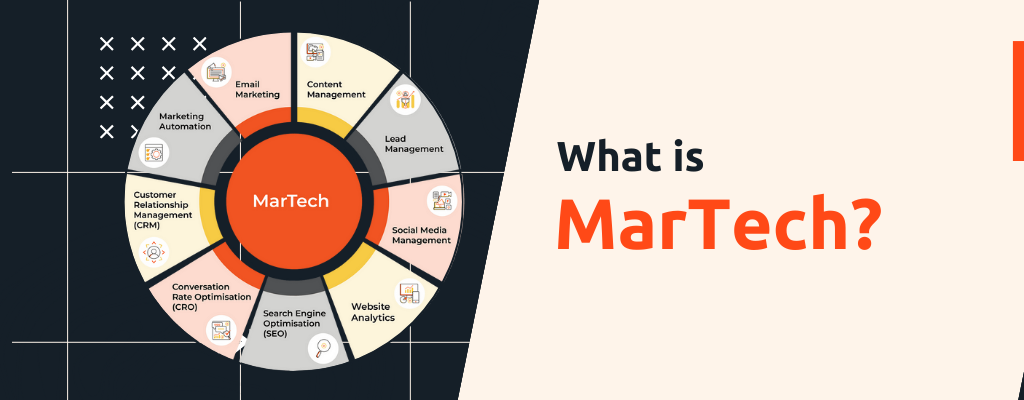


The 5-Layer MarTech Architecture Every Enterprise Needs in 2026

If you manage your company’s MarTech stack in 2026, it is most likely costing more than it’s delivering. Every year, more tools, integrations and dashboards are developed and added. However, the outcomes related to revenue, retention or experience are rarely in line with the investment that has been made.
This is a widespread issue. It is not caused by any particular tool used. The issue is due to the architecture. Specifically, the lack of a cogent way to tie all of those tools together.
This blog outlines the 5-layer MarTech architecture framework that is being implemented by many of the highest-performing marketing teams today. It covers what each layer does, why it matters and what happens when any single layer is missing or weak.

The MarTech Utilization Problem Nobody Wants to Talk About
Before examining the framework, it is worth understanding the scale of the problem.
In 2020, enterprises were using 58% of their martech stack at full utilization. By 2022, it had dropped down to 42%. In 2023, it was down to 33%. That is two consecutive years of decline in utilisation of tools, despite increasing budgets for martech and tool counts.
These numbers come directly from the Gartner Marketing Technology Survey, 2023 of marketing leaders (405 total respondents), which means the data is accurate and not an anomaly or rounding error.
The issue is not a lack of martech tools; in fact, there are more martech tool options than there have ever been. The issue is that these tools do not connect to each other in any coherent way.
This is not a technology issue. It is an integration issue.
The marketers building the highest-performing teams over the next five years will not be the ones who find the best individual tools. They will be the ones who build the most coherent architecture behind those tools.
The 5 Layer MarTech Architecture Framework
Your marketing engine will work properly when you have all 5 levels connected and functioning. If any level is missing or malfunctioning, then the overall outcome will not reach its maximum potential.
When any layer is missing or broken, the entire system underperforms, regardless of how strong the remaining layers are.

Layer 1 : Data Foundation (The layer everything else depends on)
A clean, unified and accessible data foundation is what every other layer is built on. It is not a new concept, but it remains the most consistently underbuilt layer in enterprise stacks and the one that causes the most downstream problems when it is weak.
In 2026, a strong data foundation layer is built on three components:
- Customer Data Platform (CDP): A CDP creates a single master customer profile by combining first-party behavioural data, transactional data, CRM data and offline interactions into one unified record. Without this, every layer above is working from an incomplete picture of the customer.
- Data Governance Framework: A data governance framework gives structure to how data will be collected, held, accessed and used & will be especially relevant as the world becomes increasingly regulated concerning data privacy. Data governance is no longer simply a piece of infrastructure. It has become a part of the structure required to be competitive.
- First-Party Data Strategy: Developing a first-party data strategy is necessary to develop deeper, more direct relationships with your customers through creating value exchanges, loyalty programs, and engaging content that helps reduce your dependence on the disappearing pool of third-party data.
“Nike developed a customer data platform (CDP) that integrates data across Nike.com, the Nike app, and Nike’s physical stores into a unified profile for each customer, allowing for personalized marketing, relevant product recommendations and seamless omnichannel customer experiences. Harvard Business School analysis has found that Nike used customer data to anticipate future customer behaviour with its Consumer Direct strategy and provide tailored offers at a larger scale.”

Layer 2: Intelligence & Analytics (The layer that turns data into decisions)
Data without intelligence is just storage. This layer is where raw customer data becomes actionable, where patterns emerge, predictions are made and, decisions are informed in real time rather than retrospectively.
AI has transformed this layer more dramatically than any other.
According to the Salesforce State of Marketing Report, 84% of marketers reported using AI by 2020, up from just 29% in 2018. A 186% increase in adoption in just two years.
However, most enterprises in 2026 are still using AI reactively, analysing what happened after the fact rather than predicting what will happen next.
The shift that separates high-performing teams is moving from:
Descriptive analytics – what happened
Predictive analytics – what will happen next
Prescriptive analytics – what action to take in response
Netflix employs predictive analytics and machine learning techniques to discover subscribers at risk of churning. If decreased engagement is recorded, Netflix will automatically initiate customised content suggestions for the subscriber before the subscriber churns, resulting in over $1 billion per year in saved retention revenue. (Netflix Research, 2023)

Layer 3: Engagement & Orchestration (The layer the customer actually experiences)
This is typically where the majority of enterprise MarTech budgets are spent and where the greatest waste occurs.
The Engagement and Orchestration layer includes every tool that directly touches the customer.
- Email marketing platforms
- Marketing Automation Systems
- Social media management tools
- Paid media platforms
- SMS, push notifications and in-app messaging
- AI-driven chat-based marketing tools
The problem is not too few tools in this layer. There is a lack of integration between them.
Omnisend research found that campaigns using three or more channels produce a 494% higher order rate than single-channel campaigns.
At the enterprise level, channel integration is no longer just a strategic choice. It is a measurable contributor to revenue.
Yet most enterprise marketing teams still plan and execute campaigns channel by channel with separate teams, separate budgets, and separate success metrics for each. The result is a fragmented customer experience that no amount of individual channel excellence can compensate for.
The architectural requirement for this layer in 2026 is journey orchestration, designing, automating, and optimising customer journeys across all channels simultaneously, responding to individual behaviour in real time rather than executing pre-planned sequences on fixed schedules.
Gymshark developed a personalized abandoned checkout removal program that sent customers an email reminder within 1 hour of abandoning their cart. They also sent a follow-up email reminder 24 hours later. All emails contained the customer’s first name and the exact items that they had left in their checkout cart at the time of abandonment. Due to effective, relevant, and timely communication, Gymshark experienced an improvement in recovering revenue that had previously been lost.

Layer 4: Content & Experience (The layer that delivers relevance at scale)
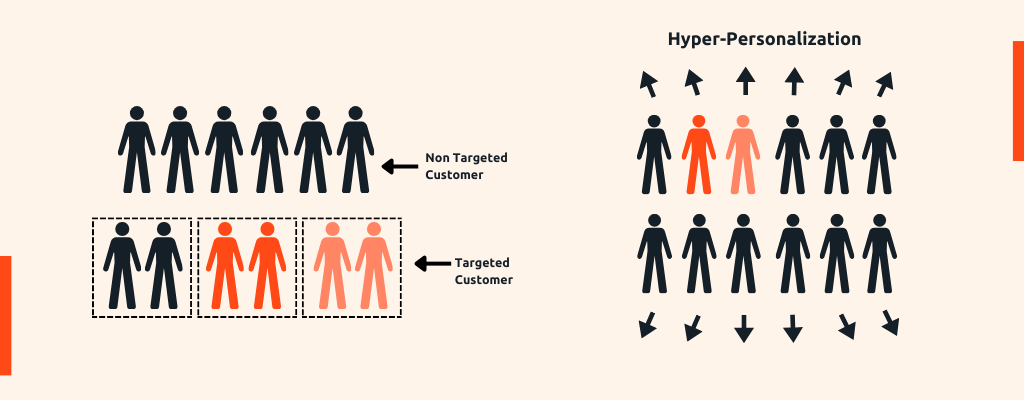
Personalisation without content is a promise without a product. This is where the intelligence from Layer 2 and the orchestration from Layer 3 materialise for the customer.
The central challenge here is what is increasingly called the content supply chain problem. The growing gap between the volume of personalised content modern marketing requires and the speed at which traditional content production can deliver it.
Consider what genuine personalisation at scale actually demands. Content variants across 50 customer segments, eight channels and twelve markets. No traditional creative team can produce that volume manually, not sustainably, and not fast enough.
According to Gartner Generative AI Prediction 2023 that by 2026, more than 80% of enterprises will have deployed generative AI applications, up from less than 5% in 2023.
This does not mean human creativity is being replaced. It means the volume of creativity required has grown beyond what human teams alone can deliver.
A strong Content and Experience layer requires three components working together:
- A Content Management System (CMS) : Tightly integrated with the intelligence layer, dynamically selecting, assembling and delivering content based on individual customer signals in real time
- A Digital Asset Management (DAM) system : That organises and version-controls creative assets at scale
- AI content generation tools that accelerate production without compromising brand integrity
Over 200 images and more than 1,000 variations were generated by IBM’s marketing group to support the launch of their new product line (IBM, 2025). This resulted in an increase of 2600% in engagement compared to using traditional means for generating engaging marketing assets. “By leveraging the power of AI tools, we are able to create all our assets in less than one day, as opposed to several days or even weeks. This has accelerated the pace at which we create new creative solutions across our many markets,” said IBM’s Director of Brand Marketing.

Layer 5 : Measurement & Optimisation (The layer that closes the loop)
The majority of businesses see the data layer solely as a tool for reporting. This misperception often leads the company into hidden costs without knowing it.
In 2026, measurement and optimization will focus less on creating reports through dashboards. Rather, this will involve establishing a framework for learning within an enterprise.
- To understand successes and failures
- To comprehend the successes and failures relative to each customer segment
- To determine costs versus returns on investments
- The extent to which the lessons learned from a given report influence each layer above this point.
Understanding What This Means to Your Business
The 5-layer framework is not only for large enterprises with massive finances. Every marketer is influenced by the complexity of modern-day marketing. Think of it as the foundational layer that supports the volume of marketing you are doing, regardless of the size of your business or how you are organised.
The statistic from Gartner quoted in the introduction (33% stack utilisation) does not reflect poor purchasing practices. Rather, it is the product of poor integrations, architecture, and strategic thought on how to make your tools work together instead of simply selecting which tools to purchase.
From this, we can draw one clear conclusion. No competitor will gain an advantage in 2026 by having superior tools. The advantage will go to those who create a more cohesive system around the tools that they currently have access to.
To do so, step one is to conduct an assessment to find the weakest area of your 5- layer stack. That is where your weakest link is found, and that is also, in most cases, the same place that revenue is leaking from your business without you being aware of it.
The companies that will dominate the marketing game over the next five years will not be determined by the quantity of tools they own. But rather by the quality of the craftsmanship put into developing a cohesive systems architecture behind those tools.
Is Your MarTech Stack Holding You Back?
If your MarTech stack is not delivering results, the issue may not be your tools. It may be your architecture. Identify which layer is holding you back and start closing the gap today!