

Prime One Logo
  • Who We Are
    • Our Story
    • The Team
    • Insights
    • Community
    • Join Us
  • What We Do
    • Performance Marketing
      • PPC Campaign Management
      • Experiential Marketing
    • Business Intelligence
      • Digital Marketing Strategy
      • Page Speed Optimization
      • Conversion Rate Optimization
    • Search Engine Optimization
      • Enterprise SEO
      • Link Building
      • Local SEO
      • Link Removal
  • Digital SQUAD
  • Clients & Results
  • Partners
HELP
  • Who We Are
    • Our Story
    • The Team
    • Insights
    • Community
    • Join Us
  • What We Do
    • Performance Marketing
      • PPC Campaign Management
      • Experiential Marketing
    • Business Intelligence
      • Digital Marketing Strategy
      • Page Speed Optimization
      • Conversion Rate Optimization
    • Search Engine Optimization
      • Enterprise SEO
      • Link Building
      • Local SEO
      • Link Removal
  • Digital SQUAD
  • Clients & Results
  • Partners
  • Who We Are
    • Our Story
    • The Team
    • Insights
    • Community
    • Join Us
  • What We Do
    • Performance Marketing
      • PPC Campaign Management
      • Experiential Marketing
    • Business Intelligence
      • Digital Marketing Strategy
      • Page Speed Optimization
      • Conversion Rate Optimization
    • Search Engine Optimization
      • Enterprise SEO
      • Link Building
      • Local SEO
      • Link Removal
  • Digital SQUAD
  • Clients & Results
  • Partners
Marketing
Home Archive by Category "Marketing"

Category: Marketing

02 JulMarketingPerformance Marketing

The CAC-LTV Formula: A Performance Marketing Guide to Profitable Growth

Picture of Vithusha

Vithusha

Every marketing team is familiar with how to invest in customers. There are proportionately far fewer who even know whether such expenditure is sensible. This is where the CAC-LTV formula comes into play. It is a straightforward way to see whether your growth is viable or you are purchasing customers at a loss with the hope that things will work out in the future.

In this guide, you’ll learn what CAC and LTV are, how to calculate them and use that single ratio to decide smarter marketing.

What Is CAC?

CAC is the acronym for Customer Acquisition Cost. It’s the average monetary value you put into acquiring a customer.

The formula is simple:

  • CAC is calculated using the following formula: Total Sales and Marketing Spend / Number of New Customers Acquired

If you have spent $50,000 on ads, content and your sales staff last quarter and that generated 500 new customers, your CAC is $100. That means you have to pay $100 for each of your new customers.

Every marketing approach related to acquiring that customer should go under the CAC umbrella, which is why it shouldn’t stand alone in tracking ad spend. That means:

  • The finances of paid ad expenses (Google, Facebook, LinkedIn, etc.).
  • Commission for sales personnel
  • The following tools and/or software are used for campaigns.
  • Content production costs

You might want to avoid leaving any of these items out because they make your CAC seem stronger than it really is, and that can result in poor decisions.

cac-formula-in-marketing

What Is LTV?

LTV is a term for Lifetime Value (also known as Customer Lifetime Value, or CLTV). It’s the lifetime value of all the revenue you can anticipate from one customer.

A simple formula is:

LTV = Average Purchase Value x Purchase Frequency x Customer Lifespan

Subscription businesses have it easier, however:

LTV = (AMRpC × ACL) / discounted number of customers.

Assume the customer pays you $50 per month, and stays on average for 20 months. Their LTV is $1,000.

LTV is not just telling you about the value of a customer on day one, but over the entire customer relationship. This is important as customer acquisition will become more expensive, but certain customers will have significantly longer life cycles and higher dollar value, and thus are worth the additional expense.

Understand the significance of the CAC-LTV ratio in marketing.

ltv-cac-ttv-ratio-infographic
Knowing CAC and LTV, you can determine the important ratio is:

The ratio of LTV/CAC indicates the LTV÷CAC.

This one single number will tell you whether or not your business model is capable of survival. The following is an explanation of how to read it:

  • Less than 1:1 – You’re out of money with every customer. However, it is an error to spend more to grow for the sake of growth, and thereby make matters worse, not better.
  • At about 1:1 – You are even. No room for profit, overhead or mistakes.
  •  3:1 – This is the benchmark that many SaaS and subscription businesses strive for. Acquiring a customer costs $1 and they return $3 times that. It takes $1, but it returns $3. It indicates healthy, sustainable growth.
  • 5:1 or better – This would seem perfect, but may be a warning sign. It will normally mean that your spending is not adequate for growth and that you would be finding customers if you spent more on marketing.

While a 3:1 ratio may not be the magic number for all businesses, it is a popular metric because it allows for a balance of profits and investment in business growth.

Why so many businesses fail to get this right

Simple to calculate this on paper and yet it is easy to misread what they are saying. These are the most common errors.

  • Error #1: Defining CAC too narrowly. The first mistake is that of making CAC too narrow a definition. Many teams only include the cost of advertising/marketing and don’t consider the costs of salary, tools, and overhead. This can result in an artificially low rate of CAC and result in over-demand for scaling spending.
  • Error #2: An over-optimistic estimate of LTV. The initial temptation is to assume that customers are going to stay for a long time, especially if you don’t have a lot of churn data. A poor ratio can be made to appear healthy by overstating the LTV.
  • Error #3: Not considering the payback period. If you’re able to recover the cost of the acquisition in 3 years, then you may not have a problem even if the ratio is 3:1. Just as important as a ratio is cash flow. The quicker the payback, the sooner you can reinvest in growth.
  • Error #4: One-size-fits-all customers. When calculating either AC or LTV on a customer-wide basis, it’s easy to mask significant channel, segment, and/or plan disparities by aggregating across the entire customer population. It can be easy to overlook huge discrepancies between channels, segments and/or plans by calculating the average AC or LTV for your total customer base. One channel could be making lots of money while the other is making very little without you knowing it.
  • Error #5:Not updating the numbers regularly. CAC and LTV will change based on market, pricing and competition. The ratio is based on a year’s worth of data and may not match today’s circumstances.
strategies-to-lower cac-and-increase ltv-for-marketing-growth
Understanding how to enhance your CAC-LTV ratio.

When it’s not what you want, there are two places to go: either lower your CAC or increase your LTV. Most companies will require both.

Lowering CAC

Improve targeting. 

One of the major contributors to a high CAC is the time and money you invest in attracting the wrong kind of customer. Narrowing your targeting down to your top existing customers can quickly prove to be rewarding.

Repeat what is working. 

Review individual channels, one by one. Before spending money on costly paid avenues, allocate more resources to becoming more visible in the free channels that are driving traffic, such as search and referrals.

Improve conversion rates. 

Fixing leaks in your landing pages, sales calls, or onboarding flow without spending more money on ads will reduce your CAC.

Leverage retargeting sequences and nurture sequences. 

Not all visitors convert “on the spot. Unlike other new paid traffic, email sequences and retargeting ads can actually produce warm leads at a significantly lower cost.

Raising LTV

Reduce churn.

It’s typically the biggest lever in getting LTV up, particularly if you’re a subscription business. If you notice that you’ve made just a little bit better, that has a huge impact on your marketing outcomes over time.

Upsell and cross-sell. 

Current customers are much easier to sell to than new ones. Providing relevant upgrades or add-ons in the mix boosts revenue per customer without increasing acquisition cost.

Improve onboarding.

If the customer realises their value early, they are much more likely to stay. The power of a great onboarding experience is that it directly prolongs customer lifespan.

Develop loyalty regimes or longer-term agreements. 

Rewarding plans for the year rather than the month or for giving customers the value over a number of years will increase the average tenure and value of customers.

It’s illustrated with a simple example to easily apply.

Imagine that, for example, you are thinking of the following situation:

In the entire period, an average SaaS company spends $30,000/month for marketing, an equal amount on sales and ends up with 150 new customers.

CAC = $30,000 ÷ 150 = $200

This is true of every customer who pays $40/month and is there on average for 15 months.

LTV = $40 × 15 = $600

LTV : CAC Ratio = $600 ÷ $200 = 3:1

This is an excellent company to have in your portfolio. They spend $1 per customer acquired and can expect to receive $3 in their lifetime from those customers acquired. This ratio allows them to have the buffer to invest even more in growth, new channels, and profits.

What if there were a rise in churn and customers began to sign up for 6-month terms rather than 15-month terms?

New LTV = $40 × 6 = $240

New Ratio = $240 ÷ $200 = 1.2:1

Thereafter, the same number of acquisition costs is almost balanced by the break-even point. These numbers are indicative of the value retentions can bring to the overall profitability, often greater than acquisitions.

Final Thoughts

The CAC-LTV equation doesn’t just apply to a finance problem. It’s a valuable gauge to monitor to figure out whether your marketing system is developing a profitable business or just activity. If you feel as if you need to invest more in your business, you have one of the best ratios; if you don’t have a good ratio, then you know that you need to work on the pieces and parts of your business before you invest any more money.

In the long run, it’s not always the case that the more money the company spends on marketing, the more money the company earns. It is because they are the ones who know how, when and how much they can pay each customer, how each customer is valued and how they can value these customers more over time.

Track it. Review it regularly. Let the numbers and not just guesses inform your next move.

d4de1beab929b4b8ed0ebc88a81dd1ac12ed2fe3064db72d20465811f0b70562?s=96&d=mm&r=g

Vithusha

Vithusha is a skilled Business Content Researcher and Analyst with a passion for creating insightful, research-driven blogs and articles on business trends, market strategies, industry developments, and digital growth. With expertise in content analysis, data-driven research, and professional article writing, she delivers engaging and informative content that helps businesses and readers stay informed in a rapidly evolving market. Her work combines analytical thinking with creative storytelling to produce high-quality blogs, business reports, and strategic content tailored to modern industry needs.

All Posts

Share this article:

Read More
26 MarMarketing

The 4Ps of Marketing and How to Use Them Effectively

Picture of Nigetha

Nigetha

Table of Contents

  • 1. What is a marketing mix and why is it important?
  • 2.What are the 4Ps of marketing?
  • 3. What are the 7Ps of marketing?

Are any of you interested in learning how to utilize the marketing mix (often referred to as the 4Ps of marketing) to achieve the optimal combination of place, price, promotion, and product for your business? If so, Here we go.

Do you want to scale your business you need to have a successful marketing strategy. And we know that. But when you ask any marketing professional – what goes in my marketing strategy? They’re going to start listing various tactics they’ve learned.

  • Consider hiring an influencer!
  • Alternatively, ramp up your email campaigns!
  • Focus more on organic social media growth!

However, those are techniques, not strategies. Before you even think about a marketing plan, there’s a crucial step that often gets overlooked, that is diving into the world of the marketing mix.

A marketing mix is a tool that can assist you in determining your target market, establishing objectives, and creating a strategy for achieving them.

A key component of company strategy is the marketing mix, also known as the 4 Ps framework. Understanding how the four components—product, pricing, place, and promotion—interact is essential if you want to build your business and draw in new clients.

Product, price, place, and promotion are the four Ps in a winning “marketing mix”

This framework supports to the companies to concentrate their marketing efforts on what’s important, make smarter business choices, and develop more effective marketing strategies. It assists brands in connecting with their target customers, defining their marketing goals, and enhancing product development and promotional strategies.

The marketing mix affects everything from product marketing, pricing strategy, promotional strategy, brand positioning, and all the various marketing efforts of a business.

✅ What is a marketing mix and why is it important?
2

The marketing mix is a collection of 4 or 7 components that specify a product or service’s marketing plan. With the use of the marketing mix, you can develop an effective marketing strategy that will improve your ability to reach your target market, increase product sales, and generate revenue.

This framework supports to the companies to concentrate their marketing efforts on what’s important, make smarter business choices, and develop more effective marketing strategies. It assists brands in connecting with their target customers, defining their marketing goals, and enhancing product development and promotional strategies.

The marketing mix affects everything from product marketing, pricing strategy, promotional strategy, brand positioning, and all the various marketing efforts of a business.

✅ What are the 4Ps of marketing?
4Ps of marketing
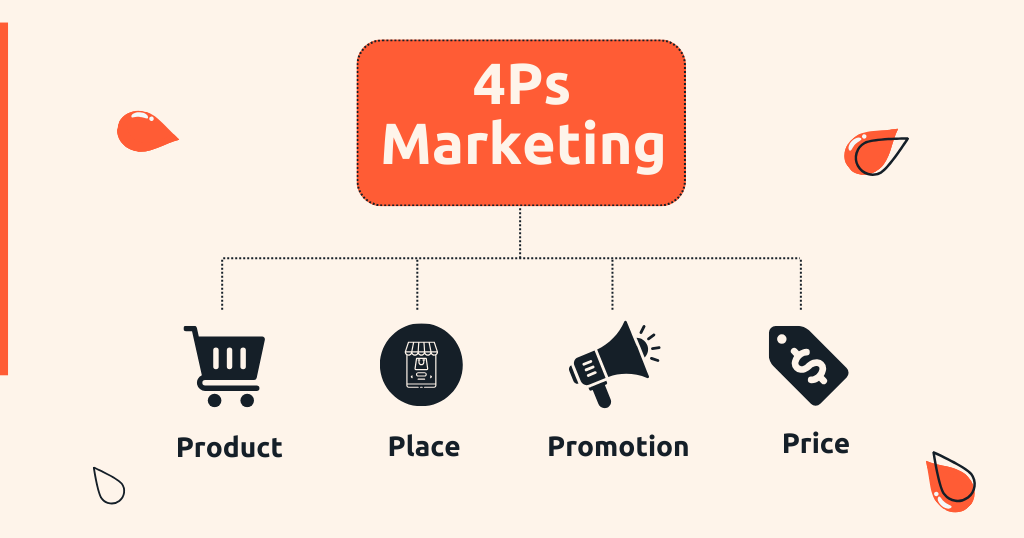
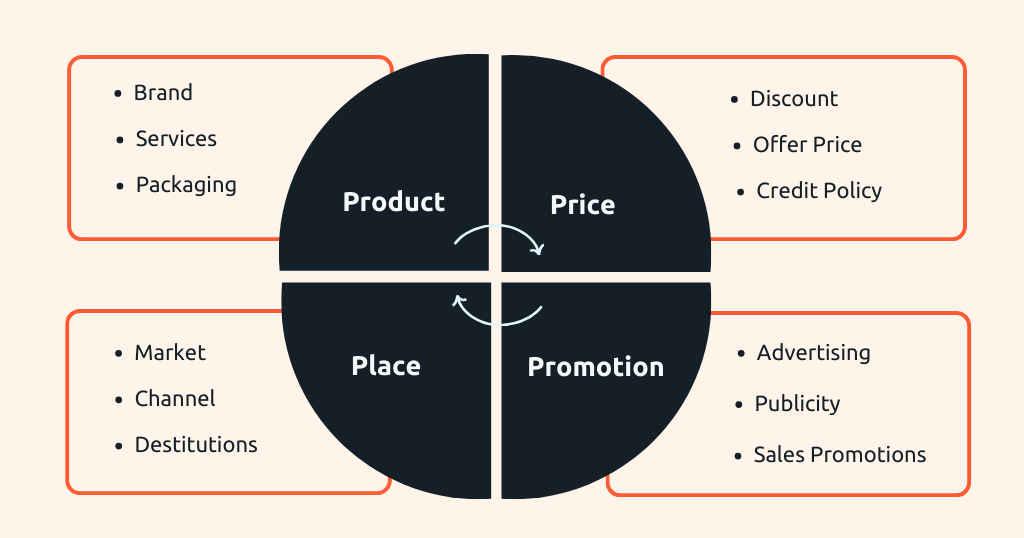
The 4 Ps are:
  • Product – What you’re selling, This is simply what you are offering for sale. It could range from physical items like electronics or clothing to services like consulting or housekeeping.
  • Price – How much it costs, It’s all about the money, baby! This is the price you’re charging for your goods or service. You have to make sure it’s just right – not too high to scare people away, and not too low to make them believe it’s rubbish.
  • Promotion – How people hear about your product (e.g., advertising), Think of this as spreading the message. How are you letting folks know about your fantastic products? You must spread the news in some way, whether through advertisements, social media, or good old-fashioned word-of-mouth.
  • Place – Where people can buy it (e.g., stores, platforms), This is all about where customers can get their hands on your products. Do you sell in-store, online, or through a fancy app? Whatever the situation, you must make it easy for people to find and purchase what you’re selling.

Having a great marketing strategy is critical for success. The 4Ps of marketing (Product, Price, Place, and Promotion) are a tried-and-true structure. Businesses that properly use these factors can create comprehensive marketing plans that engage with their target demographic and generate growth. In this post, we’ll look at how you can use the four Ps to improve your marketing strategy and reach your business goals.

Let’s explore Advanced Marketing Tools to Elevate Your Strategy.

So, marketing is no longer just about selling products. If you run a service-based business, things are a little different. You must keep your attention on the people you are serving and ensure their satisfaction at all times.

Aside from the traditional four Ps, we have three more to consider: people, process, and physical evidence.

People: These are the members of your team who engage with customers. They are the face of your firm, so make sure they are pleasant and helpful.

Process: It’s all about how you do things. You want to ensure that your service delivery runs smoothly and efficiently, and that your consumers are pleased with how things are going. 

Physical Evidence: Think of this as the environment where your customers and your team meet. It could be your office space, your website, or even your logo. You want everything to look professional and welcoming.

Let’s talk about the 4Ps in detailed:
3

Tip: Any successful marketing strategy should be revisited from time to time. The marketing mix you create is not intended to be static. It needs to be adjusted and refined as your product grows and your customer base changes.

Product: Marketing strategies revolve around the product or service being given. Understanding your product’s distinct features, benefits, and value proposition is critical for successfully presenting it in the market. Conducting market research to uncover consumer requirements and preferences will allow you to design your product to match their needs. Furthermore, ongoing innovation and improvement of your product based on client input helps assure its relevance and competitiveness in the market.

2. Place: Price influences consumer perceptions and purchase decisions. Setting the appropriate price for your product necessitates careful evaluation of a number of aspects, including production costs, rival pricing, and perceived value. Pricing research and analysis can help you find the best price point for maximizing profitability while remaining competitive in the market. Implementing pricing techniques such as discounts, bundling, or value-based pricing can also help to increase the perceived worth of your product and attract new customers.

3. Price: Price is the amount of money consumers pay for a product or service. In business, price is one of the most important elements of the marketing mix, alongside product, promotion and place. Price should be carefully managed because it’s often used as a way to communicate value and quality in your brand.

When setting prices for your products or services, you have to consider:

  • How much does creating your product cost you?
  • What does your competition charge for comparable products/services?
  • Do they have higher or lower margins?
  • Are there any gaps in pricing that would allow you to enter those spaces successfully? For each brand, pricing research is crucial because it helps decide how much to charge for a product. One way to gauge this is to monitor the prices of your competitors and contrast them with your own, taking into account product kind and seasonality.

4. Promotion: The process of communicating   your product or service to your target market is called promotion. It’s the manner in which your branding strategy is used to convey your message through physical and digital media. It can take many different forms; to name a few, there is direct marketing, public relations, sales promotion, personal branding, and advertising.

✅ Understanding the Origin of the 4Ps of Marketing

The 4Ps were created by E. Jerome McCarthy in 1960 who presented them within a managerial approach in his book “Basic Marketing: A Managerial Approach“. The book covered things like analysis, consumer behavior, market research, market segmentation, and planning. Philip Kotler popularized the approach and helped spread the 4Ps model.

There are several other approaches in marketing that are just as powerful and effective if you apply them correctly. First, let’s talk about the 5 Ps.

✅ 5 P’s of Marketing – Learn More About the Marketing Mix

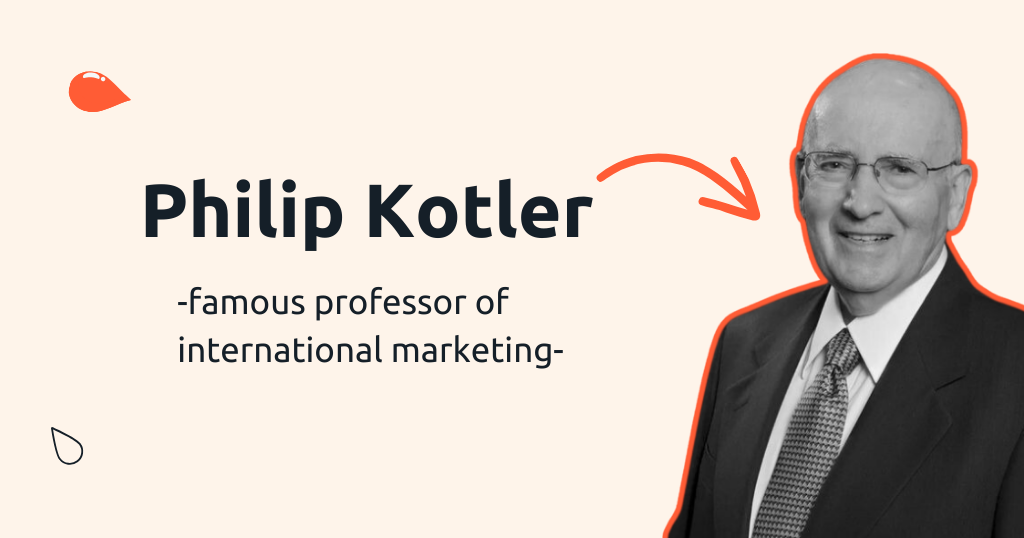
Philip Kotler, a famous professor of international marketing at Northwestern University’s Kellogg School of Management, created this paradigm. He is also credited with making the marketing mix definition more widely accepted.

Philip Kotler

So, when we talk about the “people” part of the 5P’s, we’re really diving into the vibe, the service, how the employees carry themselves, and the whole experience they create. Think about it – whether you’re dealing with a service or buying a product, how the folks representing that company act and treat you can make a huge difference, right? It’s like the heart and soul of the business vibe.

✅ How did the 5Ps become the 7Ps of marketing?

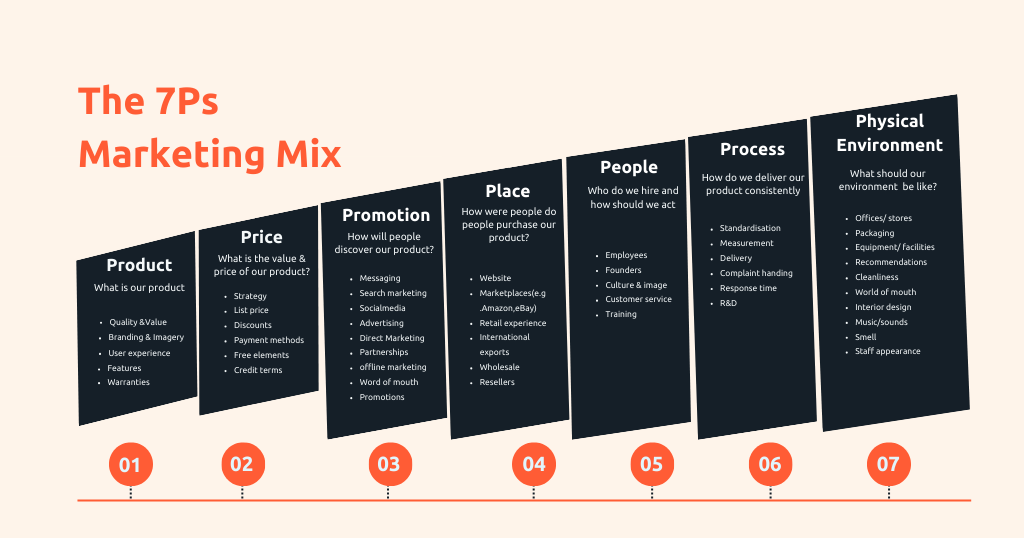
The 5 Ps of marketing worked for a while, but marketers eventually realized that the model did not cover all of the factors. In 1981, Booms and Bitner developed a 7-Ps model that included the original four aspects as well as three additional ones: people, process, and physical evidence (or physical environment).

✅ What are the 7Ps of marketing?

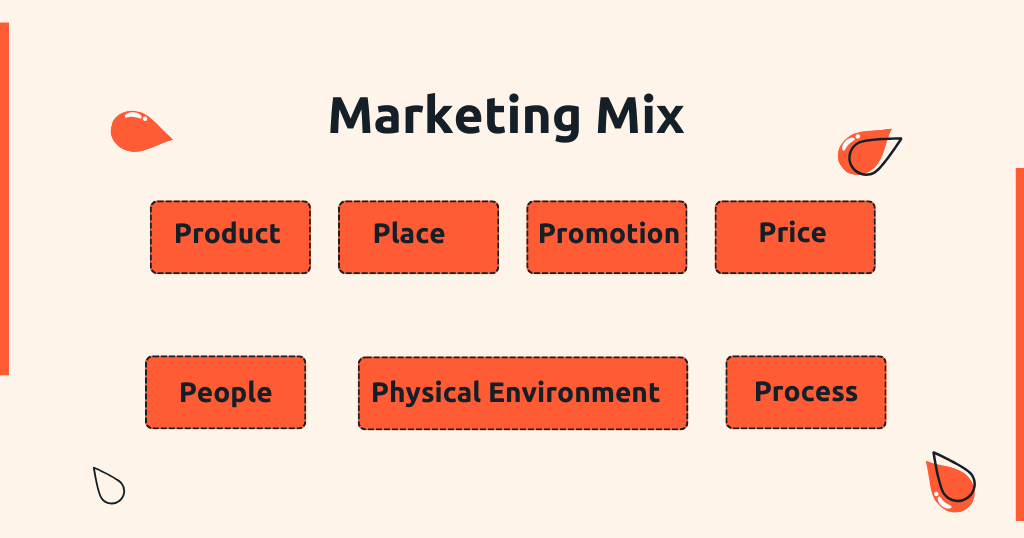
The 7Ps are known as the extended marketing mix and they are:

  • Product – Your product or service.
  • Price – How much you will charge for the product or service.
  • Place – Where you will sell your product or service (e.g., online, in a physical store).
  • Promotion – The way you advertise your products to get customers interested in buying them (e.g., social media posts and billboards).
  • People – The people who work for you, including managers and employees of your business (also known as stakeholders).
  • Process – Processes and systems that help run your business smoothly (often referred to as operations).
  • Physical evidence – the physical place where your brand exists (a store) or the environment where the actual purchase takes place.

7Ps of marketing

 
✅ 7 Principles of Customer Service You Should Follow

There is an alternative approach to the 4 Ps that was suggested by Peter Bowman in his book “Service 7”. Bowman created something called the seven service marketing principles which include – value, business development, reputation, customer service, and service design. This framework is widely used in Australia.

✅ What are the 4 C model of marketing

Another prominent framework is known as the 4Cs of marketing, which stand for consumer, cost, convenience, and communication.

  • Consumer – Rather than focusing on the product, this approach concentrates on the consumer. This is where the brand would define their ideal consumer profile and devise successful marketing methods to develop and promote a product that addresses their difficulty.
  • Cost – Price is simply one element of the issue, and this approach considers the total cost of meeting a customer’s need. This could include the cost of time spent procuring the product, the cost of conscience from consuming it, and the cost of not choosing the competitor’s product.
  • Convenience – Brands are not confined to physical channels, and they may use a variety of channels in their digital marketing mix. These may include the product’s numerous platforms, digital stores, social media networks, and online distribution channels.
  • Communication – This final category shows a greater focus on the brand’s marketing tools and channels for communicating with customers. This could involve display commercials, public relations, personal selling, direct marketing, influencer marketing, and many other things.

Wrap Up! 

The marketing mix is undeniably pivotal in driving business growth and maximizing ROI. While the traditional 7Ps framework remains invaluable, its applicability may vary across different business contexts. Before embarking on any marketing endeavor, it’s imperative to grasp the intricacies of your target audience. Tailoring your marketing strategy to meet their needs ensures relevance and effectiveness.

Now, let’s delve into the marketing mix. While it’s a valuable tool, it’s essential to acknowledge its limitations. Understanding your audience is paramount; without this insight, crafting a compelling marketing strategy becomes challenging. At Prime One Global, we recognize the complexities of navigating the marketing landscape. If you find yourself grappling with your marketing mix, fear not! Our experts are on hand to provide a Free Consultation and help refine your approach. Let’s collaborate to elevate your marketing strategy to new heights of success!

bd176233d1865e412bd0f9ace10b8a96dc36d41c5f9db9ee0f81b253f746c62a?s=96&d=mm&r=g

Nigetha

Nigetha Thurairajah, Senior Digital Marketing Manager for Partner's Growth at Prime One Global, Nigetha Thurairajah, Senior Digital Marketing Manager at Prime One Global, having more than 10 years of experience in Digital Marketing industry, specializing in Analytics and Conversion Rate Optimization. Skilled in Search Engine Optimization (SEO), Content Marketing, Analytics, Google Trends, Site Analysis, Web architecture, Competitor research and Keyword Research. I am extremely passionate about public speaking and doing podcast 🙂

All Posts

Share this article:

Read More
Recent Comments
  • Ketharan on Top 25 Instagram Fashion Influencers
  • Ketharan on Top 25 Instagram Fashion Influencers
  • Nigetha on Integrating ChatGPT With Google Sheets For Enhanced Data Analysis
  • Nigetha on The 10 Biggest Business Trends For 2024 Everyone Must Be Ready For Now
  • Nimesh Heshan on The 10 Biggest Business Trends For 2024 Everyone Must Be Ready For Now

Microsoft Certified Professional. Microsoft Certified

Start Your Journey to Better Business

Prime One Logo

Prime One Global LLC is a Globally recognized Multinational Award-Winning performance marketing agency delivering Full Stack digital marketing strategies and results-driven solutions to emerging global brands like yours.

USA Office Address

Prime One Global LLC.

1309 Coffeen Avenue,
Sheridan, WY, 82801, United States.

[email protected]

+ 1 (818) 275-2989
Sri Lankan Office Address

Prime One Global (PVT) LTD.
#146B, Goodshed Road,
Thonikkal, Vavuniya, NP,
Sri Lanka.

[email protected]

+ 94 24222 5992

Prime OneSolutionsHistory#GivebackCareersCommunity

Terms of Service

Privacy Policy

Press Kit

Knowledgebase

Support Center

Platform Status

Facebook-f Linkedin Instagram Youtube
© – Prime One Global LLC and all rights reserved by Maverick. Formerly known as Extreme SEO Internet Solutions™.