

Prime One Logo
  • Who We Are
    • Our Story
    • The Team
    • Insights
    • Community
    • Join Us
  • What We Do
    • Performance Marketing
      • PPC Campaign Management
      • Experiential Marketing
    • Business Intelligence
      • Digital Marketing Strategy
      • Page Speed Optimization
      • Conversion Rate Optimization
    • Search Engine Optimization
      • Enterprise SEO
      • Link Building
      • Local SEO
      • Link Removal
  • Digital SQUAD
  • Clients & Results
  • Partners
HELP
  • Who We Are
    • Our Story
    • The Team
    • Insights
    • Community
    • Join Us
  • What We Do
    • Performance Marketing
      • PPC Campaign Management
      • Experiential Marketing
    • Business Intelligence
      • Digital Marketing Strategy
      • Page Speed Optimization
      • Conversion Rate Optimization
    • Search Engine Optimization
      • Enterprise SEO
      • Link Building
      • Local SEO
      • Link Removal
  • Digital SQUAD
  • Clients & Results
  • Partners
  • Who We Are
    • Our Story
    • The Team
    • Insights
    • Community
    • Join Us
  • What We Do
    • Performance Marketing
      • PPC Campaign Management
      • Experiential Marketing
    • Business Intelligence
      • Digital Marketing Strategy
      • Page Speed Optimization
      • Conversion Rate Optimization
    • Search Engine Optimization
      • Enterprise SEO
      • Link Building
      • Local SEO
      • Link Removal
  • Digital SQUAD
  • Clients & Results
  • Partners
Brand Experience
Home Archive by Category "Brand Experience"

Category: Brand Experience

25 NovBrandingBrand ActivationBrand Experience

Rebranding in The AI Decade: More Than Just A Logo Change

Picture of Abirika

Abirika

Rebranding is always a major undertaking – new visuals, maybe a new name, and refreshed messaging. However, in the current AI decade, rebranding has changed. It’s no longer about how a brand looks; it’s about how it feels, behaves and adapts. It’s about building intelligence, consistency, agility and authenticity into each touchpoint of the brand. This article dives into how rebranding today is a deeply strategic endeavour, how AI is transforming the rebranding process, what are the trade-offs, practical use cases, and what are the ways in which brands can navigate the rebranding journey well. Let’s dive into the rebranding in the AI decade!

1) The Need for Strategic Brand Alignment
what-rebranding-really-is-now
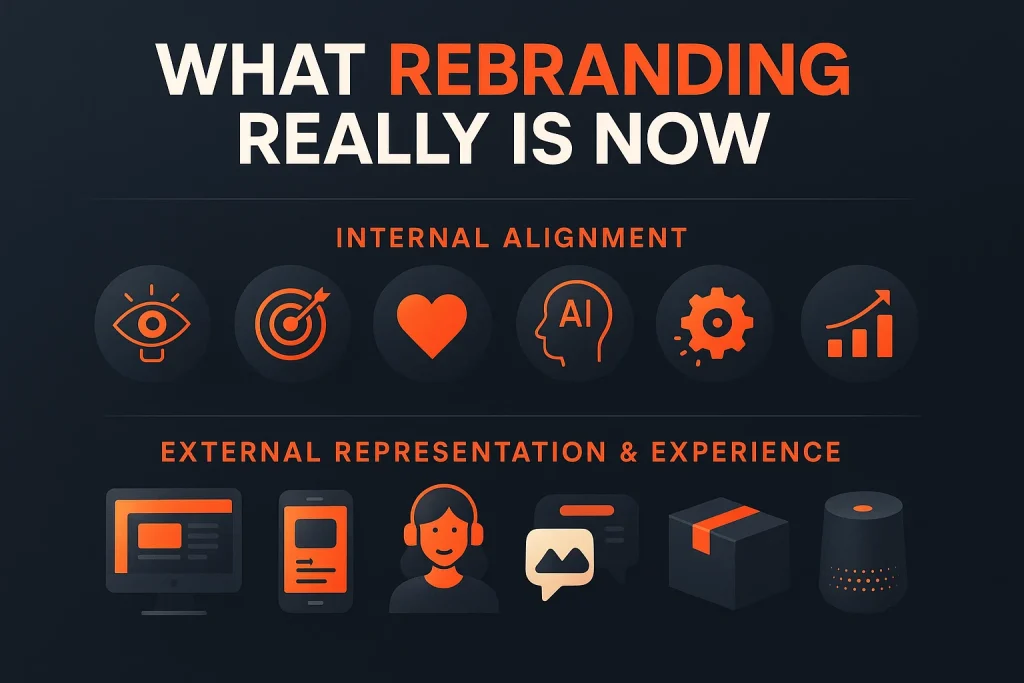
1.1. What Rebranding Really Is Now?

Traditionally, rebranding was often linked to a visual revamp – new logo, new colours, new typography. But businesses today are being transformed by rapidly shifting customer expectations, evolving technologies, environmental and ethical demands, and new competitive dynamics, particularly in the digital, AI, and data-driven platforms.

Hence, rebranding has two major dimensions:

  • Internal Alignment: Making sure that the vision, mission, values, business model and technical capabilities are aligned. If a company is headed toward more AI, more automation, more personalization or data-driven services, its brand must reflect that in brand positioning, purpose and culture.
  • External Representation & Experience: All touchpoints, including the website, product UI, customer service, marketing content, packaging, social media, and even voice assistants, must echo the new reality. Consistency, not visually but verbally, conceptually, and experientially, also becomes critical.
2) Future-Proofing the Brand

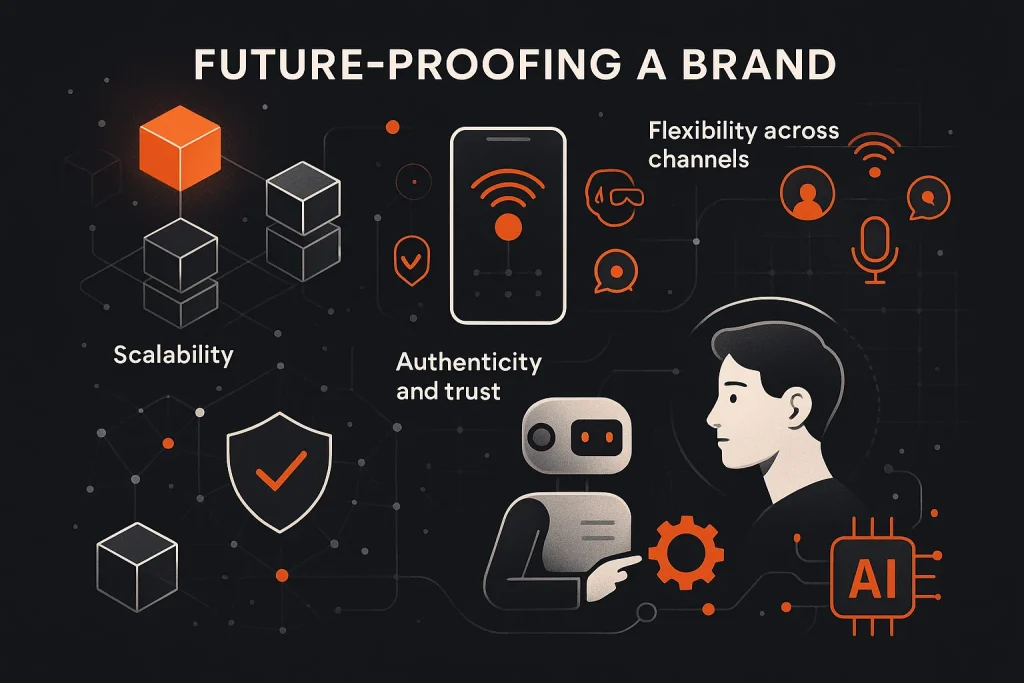
A rebrand is an opportunity to future-proof the brand. Some of the points which have to be taken into account today:

  • Scalability: As brands expand internationally across digital platforms, they need to have systems (processes + technologies) that allow for the scale of delivery without the explosion of cost.
  • Flexibility: Branding flexibility across different channels (social media, voice search, AR/VR, chatbots, etc.) without losing core identity.
  • Authenticity & Trust: Consumers are becoming more interested in values, ethics, and transparency. A brand that is seen as “manufactured” or “disconnected” will lose trust fast. Rebranding needs to include not only what you say but also how you behave.
  • Data & AI Integration: If you are integrating AI into your product or service, your brand should do so as well. And, on the brand side, AI can be used to assist with brand operations, content generation, asset management, and personalization. For many brands, rebranding is a process of investing in new tools, new workflows, and new people.

Positioning is no longer a tagline: positioning is what the brand does, what it says it will do, and how it acts in real-time.
 

branding-tips
3) The Way AI is Transforming the Rebranding Process

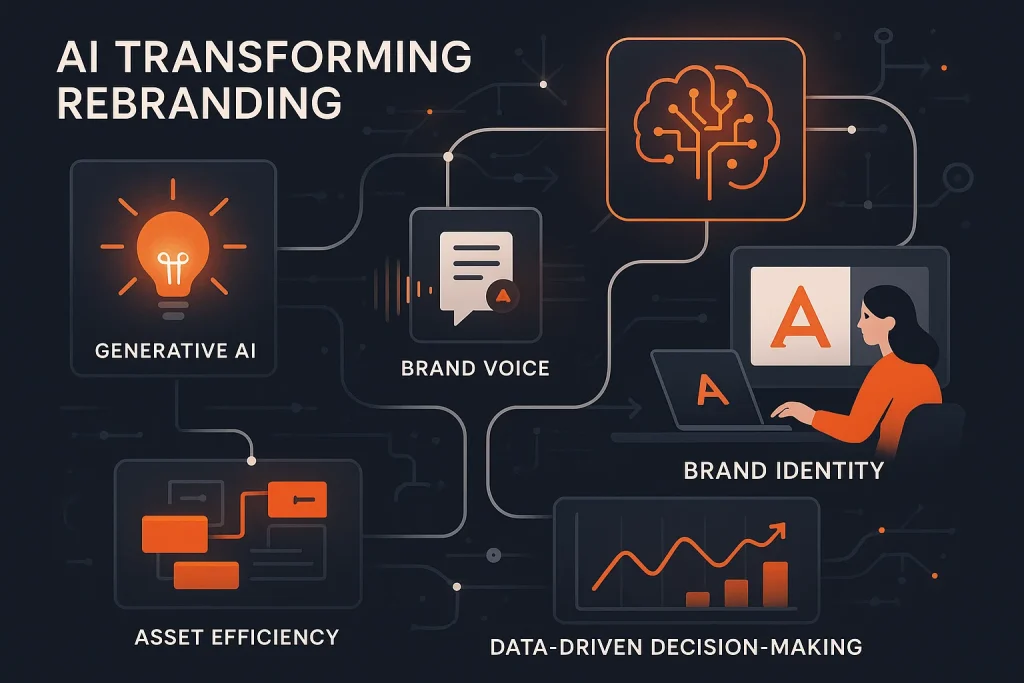
AI is not only accelerating the design process but also changing the workflow, expectations, and abilities of brand teams. These are important methods through which AI gets in and changes rebranding.

3.1. Creative Idea Generation with Generative AI
  • Creative Brainstorming: Generative AI models (text, image, and multimodel) can produce many more variants of ideas in the initial stages, such as logo ideas, changes in taglines, and voice/tone tests. These promote creative divergence: more permutations to make, and there are ideas that human beings might not come up with.
  • Speed and Iteration: It used to take weeks of sketching or agency back and forth to prototype something; now it can be done in hours. Quick draughts enable expediency in the stakeholder responses, premature failures and corrections.

But, raw AI results are inevitably required human processing and refinement.

3.2 Brand Identity System Generation Assist & Visual Design Assist
  • The AI tools can create not just logos, but complete identity systems, colour palettes, typefaces, templates, iconography, patterns, and guidelines of imagery. Certain tools also transform visuals across platforms automatically.
  • AI-based style transfer algorithms can be used to transform existing content and refashion it to fit new brand specifications (e.g. transforming older assets into a new design voice) or include seasonal/thematic modifications without changing overall visual identity.
  • We can impose visual consistency through the use of AI: e.g. automated detection of the use of off-brand logo, violations of colour, misuse of fonts. It is not necessary to manually scan each asset anymore.
3.3 Brand Voice, Messages, and Consistency of Language
  • Natural Language Processing (NLP) tools may be used to maintain the tone, voice, vocabulary, grammar, and style (e.g. across various materials, such as on the website, on social media, and with customer messages). Artificial intelligence can highlight a mismatch of tones or even provide more on-brand suggestions. 
  • Customization becomes simpler: With the audience data, AI may assist in customizing the messages to demographics (by culture, region, user preferences) without changing the fundamental brand voice.
  • Content generation: AI is able to generate the drafts of blogs, social media posts, product descriptions, etc., which can then be polished by human editors. This makes brands keep pace with demand and remain consistent in a large number of channels.
3.4 Asset / Workflow Efficiency & Governance
  • Asset management: moving old assets to new guidelines. Securing the old visuals or marketing content to be retired or renewed. All cases of an old logo or a colour may be found with the help of AI and should be replaced or flagged automatically.
  • Compliance, brand risk: Compliance tools can minimize mistakes. The legal or regulatory compliance (e.g. making sure claims in messaging are not inconsistent, affording the possibility of trademark infringement) across various jurisdictions can also be assisted by AI. 
  • Dynamic style guides version-controlled: AI or AI-assisted tools can create new style guide resources, and people can check their adherence to it (e.g. a content-creator posts something; AI determines whether the font, colour, etc. match).
3.5 Data-Driven Decision Making
  • Research and insight: AI allows investigating and processing of lots of data (feedback, reviews, social media, metrics of usage) to comprehend what the current perceptions of a brand are, what needs to be altered, and what should be valued.
  • It is more efficient to conduct A/B testing of various messages, visual communication, and even alternative brand identities with the help of AI.
  • Predictive analytics: AI helps to make decisions ahead of time, making brands evolve as opposed to responding to industry changes. E.g., seeing changes in tone/values within an industry or among consumers, and predicting them during rebranding.
rebranding-innovation-2025

4) The tradeoff between Innovation and Brand Integrity: The Issues and Risk

Although AI has strong capabilities, it creates new threats. These risks must be dealt with deliberately in the case of rebranding with AI.

4.1 Creativity, Authenticity, and Uniqueness Lost
  • Generic outputs: Due to the fact that most AI tools are trained on the same or similar data, some of the results are apt to repeat familiar patterns – there is a danger of the brands appearing to look or sound alike. 
  • Emotional context: AI does not understand context, culture, or emotion; it may be insensitive to diverse, local, vernacular, or cultural values. A message can be generic.
  • Brand voice watering down: When numerous individuals in the organization use AI prompts too much instead of edited messages, the unique voice of a brand may be diluted. As an example, when optimized towards engagement metrics, a brand might not be seen as authentic. 
4.2 Ethical, Legal and Copyright Issues
  • Problems in training data: AI models are commonly trained with scraped or open datasets. Copyright or trademark difficulties may occur when the outputs are too close to any existing designs or the training data contains copyrighted information without a licence. 
  • Biases and impartiality: When training data is biased towards society, then the outputs of AI might reinforce stereotypes or marginalisation. Global brands have a tangible threat of cultural insensitivity or unintentional offence. 
  • Openness and credibility: Customers are becoming more concerned about the way in which brands apply AI. In case the brand is greatly dependent on AI in its identity or messages, but does not make real efforts, it may not be well-received. 
  • Regulatory / privacy risks: Personalization based on the use of customer data should be in accordance with data protection legislation (GDPR, CCPA, etc.). Errors may result in regulatory risks and loss of reputation.
  • Legal risk in images and statements: In case the images created using AI duplicate the trademarks that exist, or in case the marketing texts created by AI turn out to be unverified commitments.
4.3 Operational Risks and Resistance
  • Over-dependence: When relying on AI tools excessively without human supervision, it can result in inconsistent or off-brand output.
  • Complexity of the workflow: The concepts of introducing new tools, training personnel, and updating the processes consume time, resources, and change management. It is not a set-and-forget thing; therefore, using AI  for rebranding without human input can be risky.
  • Perception risks: In case the stakeholders (employees, customers, partners) get the impression that the brand is being overly machine-made, it may cause perceived authenticity to go down. In a similar case to certain research studies, AI-generated designs were regarded as less creative or authentic. 
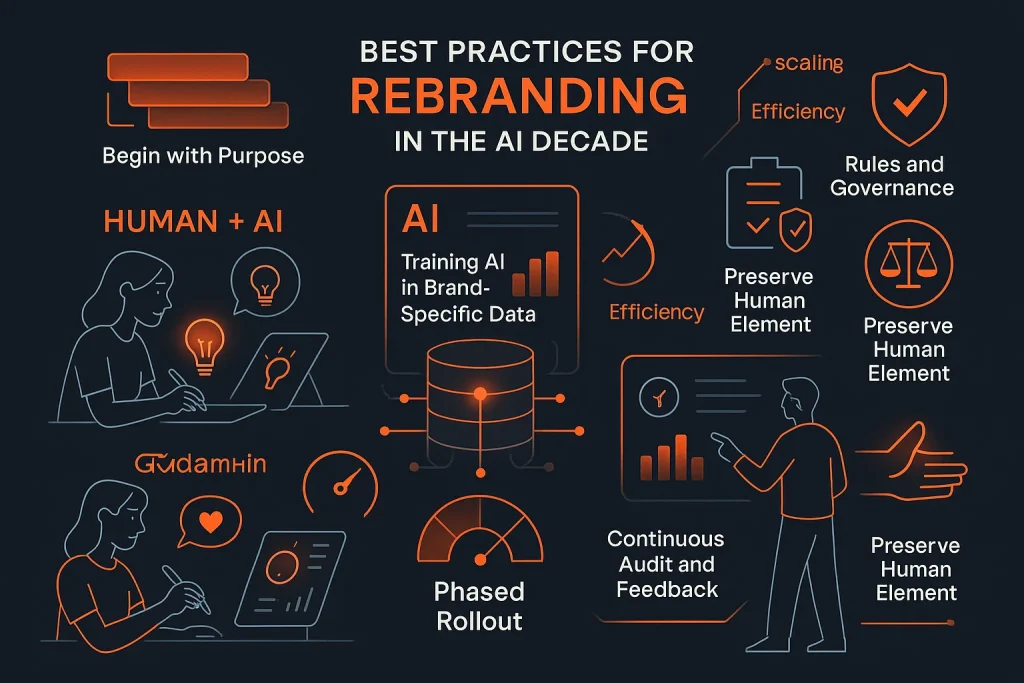
best-practices-for-rebranding

5) AI-Enabled Rebranding Best Practices and Principles
 
The brands, rebranding in the AI decade to use the advantages without falling into the traps, should embrace the following principles and practices.
5.1 . Begin with purpose
  • What is the purpose of rebranding: what do you hope to achieve by changing, what would your customers gain or what industry changes are influencing it.
  • State the fundamental identity of the brand (values, personality, differentiators) prior to involving AI. These constitute constraints/guardrails of AI.
5.2. Human + AI Collaboration
  • AI helps to ideate, scale, and improve efficiency, while human creative leadership helps to refine, direct, and add authenticity.
  • During the initial stages, style should be dictated by human designers, and progressively incorporate AI to assist and scale.
5.3. Rules, Regulations, Controls
  • Establish or revise brand guidelines to monitor AI-generated brand materials in terms of visual, voice & tone, ethics, and legal.
  • Create in-house policies regarding the use of AI: what AI tools, what data, who is monitoring results, attribution and ownership, etc.
5.4. The Models / Tools are to be Trained on Your Brand
  • Where feasible, leverage proprietary information, internal history of brand assets, previous messaging, and actual feedback of real customers to condition or refine AI models, so that the results are representative of your individual brand history and personality.
5.5. Layered and Phased Rollout
  • Do not attempt to change everything at a single stroke. Rank touchpoints: which are the most visible or the most important (e.g. digital, customer service, product).
  • Pilots test some channels or markets, gather comments, and modify.
5.6. Continuous Audit & Feedback
  • Install monitoring devices to indicate off-brand behaviour, visual discrepancies, and tone aberration.
  • Do measurements of brand perception, trust, consistency, and recognition. Gather quantitative (polls, usage rates) and qualitative (clients’ feedback, focus groups) data.
5.7. Ethical Transparency
  • Be transparent inside and outside regarding the application of AI.
  • Make sure that the rights to ownership, copyright, and the source materials are not infringed.
  • Be diverse, cultural, private, and fair with your use of AI
5.8. Preserve the Human Element
  • Narratives, tales, and sympathetic communication are important. AI may assist in repeating, but human experience is unique, and it creates an emotional bond.
  • When it comes to creative implementation (photography, storytelling, design flourishes), human touch can readily be the factor.
AI Application Examples and Case Studies

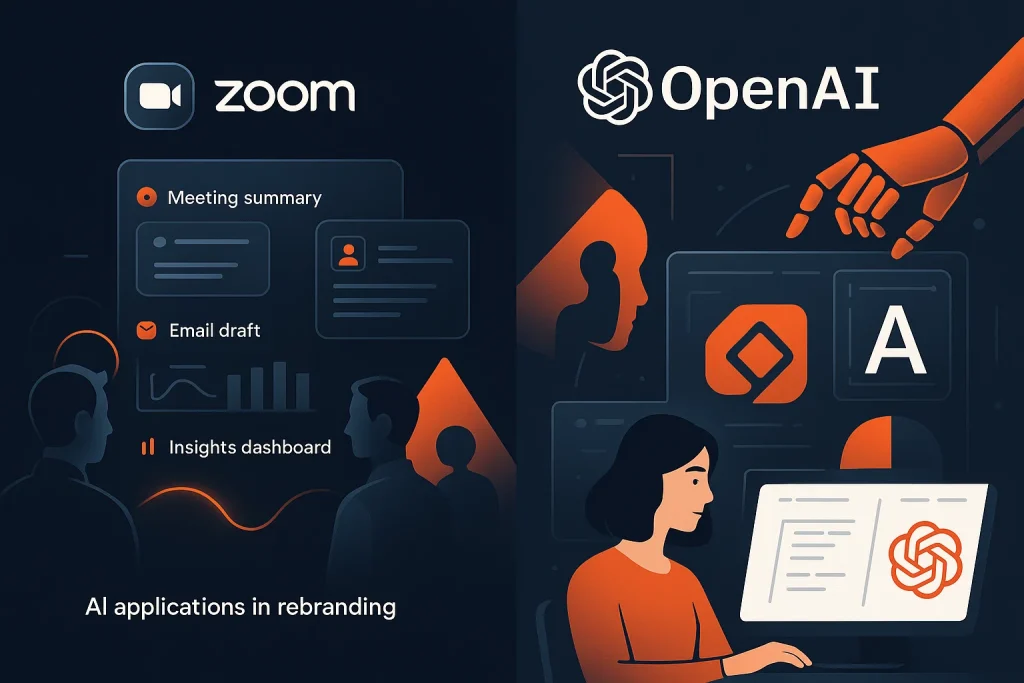
6) AI Application Examples and Case Studies.

The following are specific illustrations of AI applications in rebranding, where AI is being used by the brands for the rebranding processes:

6.1.  Zoom: Reinventing as an AI-First Company

Zoom was rebranded as Zoom Communications Inc., with an AI-first approach. This rebranding goes beyond a cosmetic change; it signifies their move towards incorporating AI-oriented features (e.g. summarization, email preparer, meeting insights) to make the work experience different. 

Lessons:

  • Rebranding was the alignment of the company name and identity with its dynamic product roadmap.
  • It had to change internally: investments in technology, product positioning, and advertising.
  • It also increased the expectations: the brand is now required to provide actual AI-based value and not mere market rhetoric.
6.2. OpenAI’s New Visual Identity

OpenAI also changed its logo and adopted a new typeface (OpenAI Sans), and improved the colour palette, which is intended to make it look more organic and human. Designers harmonised the accuracy of geometry with more accessible building elements. Part of an AI application (e.g. type weight computation) supplements human design.

Lessons:

  • Small details can convey large changes: even small changes (spacing of logos, the changes in a typeface) can pass the message of change.
  • Human-AI interaction: AI is employed as an aid, not as a substitute, and human designers guide the design.
  • Focus on the approachability and humanization – a recognition of the fact that tech brands should be warm, trusted, and approachable.
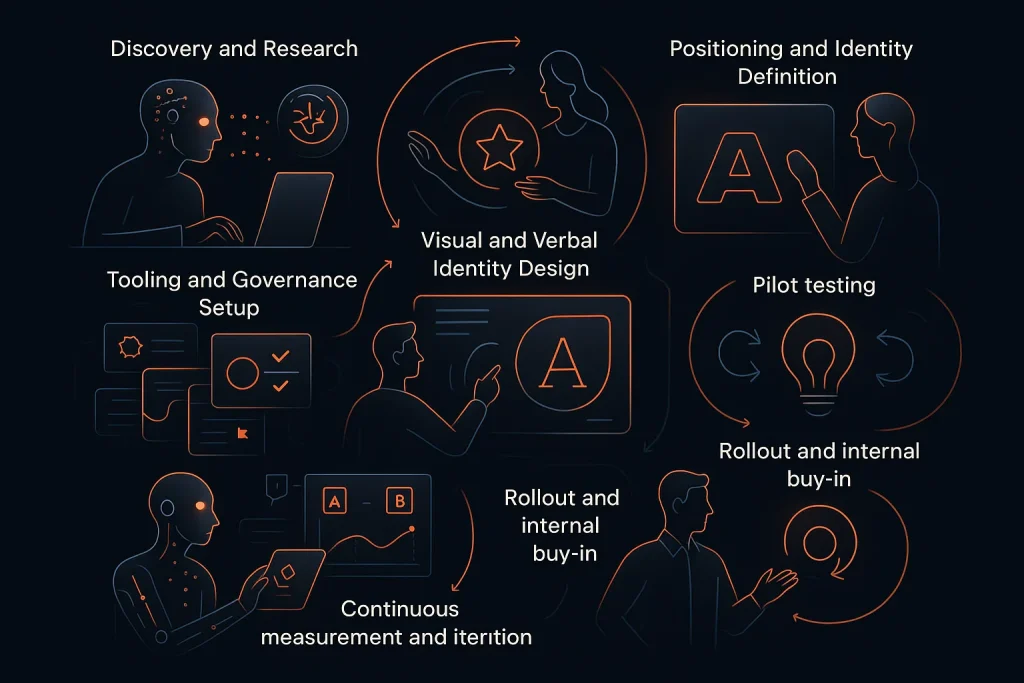
Rebranding Strategy Framework in the AI Decade

7) Rebranding Strategy Framework in the AI Decade.

Rebranding in the AI  age will not be just a new logo or tagline but a redefining of how a brand learns, develops and networks in an AI-driven world. The brands can find a viable model to sail through this shift and be innovative and in charge, as shown below.

7.1. Discovery & Research

Begin with deep listening. AI can analyse customer feedback, identify market trends and competition. Balance evidence-based decision-making and human judgment to achieve cultural insights and offline facts.

7.2. Positioning and Identity Defining

Rediscover mission, values and brand personality. Artificial intelligence can help to test the message, make experiments with the wording, pursue creative paths, but the most crucial storyline must remain the story that is genuinely human. It is supposed to be understandable, not to conform.

7.3. Identity Design: Visual and Verbal

Use human imagination and the generative abilities of AI to design. AI can be leveraged to test design, colour palette, and tone of voice, but all that should be meant to work with your brand’s strategic purpose and emotional appeal.

7.4. Tooling & Governance Setup

Design the system to develop your brand on a long-term basis. AI can be used to automate templates, compliance checks and asset management, but human control is required to ensure brand integrity and intent.

7.5. Pilot & Testing

Carry out a pilot test to introduce new images and text. Quickly conduct A/B tests, conduct feedback analysis, and sentiment monitoring using AI to enable you to make minor adjustments to your product before making it entirely available.

7.6. Rollout & Internal Buy-In

Rebranding is internal and external at the same time. Optimize asset updates and consistent tracking using AI and invest in human-controlled training and narratives to produce a phenomenal buy-in between teams.

7.7. Measurement & Iteration

Work your brand as a living system. Use AI-driven analytics and sentiment analysis to measure awareness, trust, and consistency and repeat the process on an ongoing basis on the foundation of real-life responses and cultural change.

The successful rebrands of the AI era will not be replaced by the AI tools but create the appropriate balance between automation and the human touch applied to them, which makes them authentic.


8) Metrics & KPIs to Track

Here are some of the metrics that the brands must monitor to gauge success in rebranding:
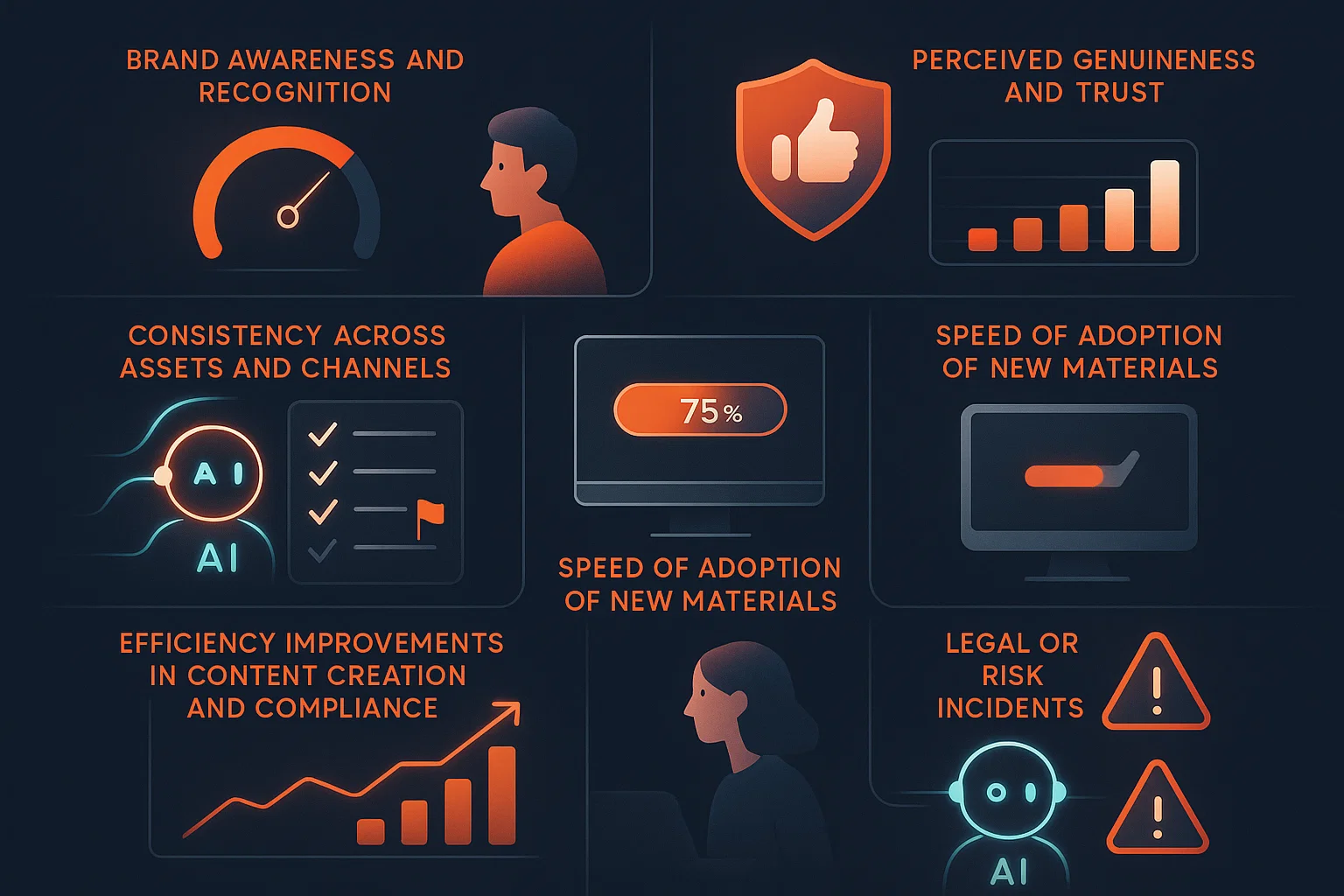
Metrics KPIs to Track

  • Brand awareness/recognition: pre-rebrand and post-rebrand brand tracking, Surveys, and recall studies.
  • Perceived genuineness / belief: Customer feeling, trust scores, reviews.
  • Consistency: Count of off-brand assets flagged, visual inconsistencies, and channel deviations of the message.
  • Speed of adoption: How fast are old materials depreciated/changed; internal ease of use and comfort with new tools and guidelines.
  • Efficiency improvement: Time is saved in the creation of content, costs of compliance are decreased.
  • Engagement indicators: Are new visuals or voice-based engagements more effective (clicks, shares, dwell time, retention) to audiences?
  • Legal / risk incidents: Any problems with copyright, regulatory non-compliance.

9) Major Pitfalls of Using AI in Rebranding.

Here are some of the pitfalls we can face when using AI in rebranding:

  • Blandness: When many brands employ similar AI tools, which have a matching prompt, it will become homogenized. Brands are becoming similar. The danger is that you will get generic in the course of being modern/scalable.
  • Consumer-backlash / authenticity issue: Once customers find out that the visuals or message have been created with a high degree of AI-generated content without any form of guarantee, they will be doubtful of the brand. Moreover, the reputational harm occurs due to the possibility that AI output is derivative or otherwise IP-breaching.
  • Overpromising: The rebrands that claim they will do everything they can with AI and fail to do it – consumers may feel betrayed.
  • Culture misfit: It happens that sometimes the brand promise fails to fit the internal culture or capability. E.g. you promote the brand as an AI brand, yet the customer care service is manual and slow, which creates a gap.
  • Lack of attention to human voice: The tone is unheard in the situation when it is all generated automatically. Delicate but important narrative or storytelling facts are lost.

10) Recommendations on the Responsible Implementation of AI

Here are the recommendations to make AI use in the rebranding process accountable:

  • Openness and Honesty: Be transparent about what is AI-generated, and ensure the contents are not misleading. Utilise ethically sourced datasets; copyright has to be respected.
  • Bias Audits: Frequently, the audits of AI-generated content are conducted to identify bias (gender, race, culture, etc.). Engage different teams and opinions on the output reviews.
  • Supervision by human beings on every level: Beginning with the idea, up to the finished product, human inputs need to be there to correct and give approval.
  • Data protection/privacy: When personalization is involved, use the customer data, also ensure that the use of customer data is legal. Use anonymity where required.
  • Life-long learning: The AI tools constantly evolve and, therefore, observe the new features, opportunities, new risks, and incorporate feedback loops.
Rediscover Rebranding in the Age of AI

Rebranding is not an option for the AI decade but a requirement for numerous businesses. The marketplace is evolving at a frightening pace: customers want the brands to act cleverly, be predictable, fast, to be transparent, and display values. A brand that is outdated will be dead.

Rebranding does not imply cosmetic change. It must be tactical: It must fit the reasons and look simple on the surface, combine human resourcefulness with artificial intelligence, authenticity, and risk mitigation. Well-executed brands will enjoy considerable acceleration with rebranding, with the use of AI in velocity, uniformity, magnitude, and advancement.  Rebranding with AI will provide a substantial competitive advantage for brands.

Have you already experimented with AI in your branding or rebranding process? What results did you achieve? Let’s discuss in the comments!


d525ceaee11862a41343afdd05eeb9e03cc8502270863e10f352a11c7b241df5?s=96&d=mm&r=g

Abirika

Abirika Soolabanee working as a Senior Manager - Inbound Marketing & Branding at Prime One Global. She is a certified content and Inbound marketer with five years of experience. Bringing expertise in content marketing, inbound marketing, branding, blogging, copywriting, SEO, keyword research, and research & analytics. She is passionate about Inbound Marketing, Branding and Blogging. She writes in-depth articles and guides about digital marketing trends, technologies, and other lifestyle topics since 2018. Through her writings, she loves to help people in all aspects of their life.

All Posts

Share this article:

Read More
29 MarUser-Generated ContentBrand ExperienceBranding

The Power of User-Generated Content: Leveraging Authenticity for Brand Growth


In the digital age, where every interaction leaves a trace and every opinion holds weight, authenticity has become the currency of trust. Consumers are no longer swayed solely by polished advertising campaigns; instead, they seek genuine connections with brands that resonate with their values and experiences. This is where user-generated content (UGC) entered in! UGC taps into the raw, unfiltered voices of the audience.

In this age of social media dominance, where platforms like Instagram, TikTok, and Twitter become popular, the influence of UGC has soared to unprecedented heights. From captivating images and heartfelt testimonials to entertaining videos and insightful reviews, user-generated content has the power to shape perceptions, drive engagement, and ultimately, fuel brand growth. But what exactly is user-generated content, and why has it become the cornerstone of modern marketing strategies? Join us on a journey as we delve deep into the realm of UGC, exploring its transformative potential and uncovering how brands can leverage authenticity to unlock unparalleled success.

What is User-Generated Content (UGC)?

User-generated content refers to any form of content, such as photos, videos, reviews, testimonials, or social media posts, created by consumers rather than brands themselves. This content is often shared on social media platforms, forums, or review sites and can have a significant impact on brand perception and buyers purchasing decisions.

The Authenticity Advantage of User-Generated Content 

One of the key reasons why user-generated content is so powerful is its authenticity. Unlike traditional marketing content, which is often perceived as biased or overly promotional, UGC is created by real people, sharing their genuine experiences with a brand or product. This authenticity resonates with other consumers, fostering trust and credibility in ways that traditional advertising cannot match.

Benefits of Leveraging User-Generated Content

Let’s explore the myriad benefits that businesses can reap by embracing and harnessing the potential of user-generated content in their marketing strategies.

1. Building Trust

Building trust through leveraging user-generated content (UGC) is a cornerstone strategy for businesses aiming to establish credibility and foster authentic connections with their audience. User-generated content, ranging from reviews and testimonials to social media posts and product photos, serves as powerful social proof that can significantly influence purchasing decisions. By incorporating UGC into their marketing efforts, businesses demonstrate transparency and reliability, showcasing real-life experiences and opinions from satisfied customers. This transparency builds trust by providing potential customers with genuine insights into the product or service, helping to alleviate doubts or skepticism they may have.

building-trust-user-generated-content

Moreover, UGC often resonates more strongly with consumers than branded content because it feels more authentic and relatable. When individuals see others like themselves endorsing a product or service, they are more likely to trust the brand and feel confident in their purchasing decisions. Leveraging user-generated content not only enhances brand credibility but also cultivates a sense of community and trust among customers, ultimately driving engagement, loyalty, and sales.

2. Enhancing Engagement

Leveraging user-generated content (UGC) is a powerful strategy for enhancing engagement between businesses and their audience. UGC, fosters a dynamic interaction between brands and consumers, leading to increased engagement levels. One key way UGC boosts engagement is by encouraging active participation from customers. When individuals see their content featured by a brand, whether it’s a photo shared on social media or a review posted on a website, they feel valued and recognized. This acknowledgment motivates them to further engage with the brand, whether it’s by sharing more content, participating in discussions, or interacting with other users.

enhancing-engagement

Additionally, UGC sparks conversations and facilitates genuine interactions among customers. When people see others sharing their experiences or opinions about a product or service, they are more likely to join the conversation, share their own thoughts, or seek advice from fellow consumers. This community-driven engagement creates a sense of belonging and fosters a loyal customer base. Furthermore, UGC humanizes the brand by showcasing real people and their authentic experiences. This authenticity resonates with consumers, leading to deeper connections and increased trust in the brand. As a result, customers are more likely to engage with UGC and share it with their networks, further amplifying the brand’s reach and engagement. Leveraging user-generated content not only increases engagement levels but also strengthens the relationship between brands and consumers, leading to long-term loyalty and advocacy.

3. Amplifying Reach

Utilizing user-generated content (UGC) is an effective strategy for amplifying reach and expanding brand visibility. Firstly, when customers share their experiences with a product or service through UGC on social media platforms, they are essentially acting as brand advocates. Their posts reach their own networks of friends, family, and followers, potentially exposing the brand to new audiences that might not have been reached through traditional marketing channels. Moreover, UGC tends to have higher credibility and authenticity compared to branded content. When people see real customers sharing their positive experiences or showcasing products in real-life scenarios, they are more likely to trust the information and engage with the content. This trust leads to higher engagement rates and increases the likelihood of the content being shared further, thus expanding the brand’s reach organically.

amplifying-reach

Additionally, UGC can also be leveraged by brands to create more personalized and targeted marketing campaigns. By curating and repurposing user-generated content, businesses can tailor their messaging to specific audience segments, increasing relevance and resonance. This personalized approach enhances the likelihood of reaching and resonating with potential customers across various demographics and interests. By harnessing the power of user-generated content, brands can amplify their reach far beyond their own marketing efforts, tapping into the vast networks of their satisfied customers and followers. This broader reach not only increases brand visibility but also cultivates a community of engaged advocates who continue to promote the brand through their authentic experiences and endorsements.

4. Driving Conversions

Leveraging user-generated content (UGC) can be a potent driver of conversions for businesses. One key way UGC drives conversions is by building trust and credibility with potential customers. When individuals see authentic experiences and opinions from fellow consumers, they are more likely to trust the brand and feel confident in making a purchase. Positive UGC reassures potential buyers that others have had satisfactory experiences with the product or service, thereby reducing uncertainty and hesitation. Moreover, UGC provides real-life examples of the product or service in action, helping potential customers envision themselves using it. Whether it’s seeing photos of happy customers using a product or reading glowing reviews about its benefits, UGC helps create a sense of desire and urgency, motivating individuals to take action and make a purchase.

driving-conversions

Additionally, UGC often resonates more strongly with consumers than branded content because it feels genuine and relatable. When people see others like themselves endorsing a product or service, they are more inclined to believe the authenticity of the message and are thus more likely to convert. Furthermore, UGC can serve as valuable social proof across various stages of the buyer’s journey, from initial awareness to final purchase decision. By strategically incorporating UGC into marketing campaigns, businesses can effectively guide potential customers through the conversion funnel, nudging them closer towards making a purchase. Overall, leveraging user-generated content not only boosts trust and credibility but also inspires confidence and drives conversions by providing real-life examples and authentic endorsements that resonate with potential customers. By harnessing the power of UGC, businesses can significantly increase their conversion rates and ultimately drive revenue growth.

Strategies for Harnessing the Power of UGC

Let’s check out the effective strategies that businesses can employ to leverage the power of user-generated content to drive brand awareness, foster authenticity, and nurture meaningful relationships with their customers.

1. Create Branded Hashtags

Harnessing the power of user-generated content (UGC) is a pivotal strategy for brands aiming to amplify their online presence and foster deeper engagement with their audience. One effective tactic within this strategy is the creation and promotion of branded hashtags. Branded hashtags serve as a bridge between the brand and its community, empowering users to contribute content while associating it directly with the brand. By establishing unique, catchy hashtags that encapsulate the brand’s essence or specific campaigns, companies can encourage users to share their experiences, opinions, and creations within the framework provided by the hashtag. This not only facilitates organic content creation but also enables brands to track and curate UGC easily, fostering a sense of community and belonging among their followers.

create-branded- hashtags-user-generated-content

Moreover, branded hashtags can significantly enhance the visibility and reach of a brand’s content across various social media platforms. When users engage with branded hashtags by incorporating them into their posts, they effectively become brand advocates, amplifying the brand’s message to their own networks. This user-driven dissemination of content not only expands the brand’s digital footprint but also lends authenticity and credibility to its marketing efforts. Furthermore, leveraging branded hashtags in conjunction with user-generated content can initiate conversations, spark trends, and cultivate a vibrant online community centered around the brand, ultimately driving brand awareness, loyalty, and ultimately, conversions. By strategically integrating branded hashtags into their marketing initiatives, brands can tap into the immense potential of UGC to forge meaningful connections with their audience and propel their digital marketing endeavours to new heights.

2. Run Contests or Challenges

Running contests or challenges is a dynamic strategy for harnessing the power of user-generated content (UGC) and fostering active engagement with a brand’s audience. By designing contests or challenges that encourage participants to create and share content related to the brand, companies can stimulate creativity and drive interaction. Whether it’s asking users to submit photos, videos, or written entries showcasing their experiences with the brand’s products or services, contests and challenges provide a structured framework for UGC generation. This not only generates excitement among existing followers but also attracts new participants who are eager to showcase their talents and potentially win prizes or recognition.

run-contests-or-challenges

Moreover, contests and challenges serve as powerful tools for expanding a brand’s reach and visibility across social media platforms. When participants share their entries, they inherently promote the brand to their own networks, amplifying its message and potentially reaching audiences that may not have been exposed to the brand otherwise. Additionally, the competitive aspect of contests and challenges can stimulate increased engagement and participation as participants contend for prizes or bragging rights. By strategically designing contests and challenges that align with the brand’s values and resonate with its target audience, companies can inspire a steady stream of user-generated content, enrich their digital presence, and cultivate a community of loyal and enthusiastic brand advocates.

3. Feature User Stories

Featuring user stories is a strong strategy for harnessing the power of user-generated content (UGC) and fostering authentic connections between a brand and its audience. By highlighting the experiences, testimonials, and successes of real users, companies can showcase the tangible impact of their products or services on people’s lives. User stories add a human element to the brand’s marketing efforts, making them relatable and compelling to potential customers. Whether it’s through written testimonials, video testimonials, or social media posts, featuring user stories allows brands to leverage the authentic voices of their satisfied customers to build trust and credibility.

feature-user-stories

Furthermore, featuring user stories can serve as a catalyst for community engagement and brand advocacy. When users see their own stories being shared by the brand, it fosters a sense of validation and appreciation, strengthening their connection to the brand. This, in turn, encourages them to further engage with the brand, whether it’s by sharing their own stories, participating in discussions, or advocating for the brand within their own networks. By amplifying user stories across various marketing channels, companies can not only inspire confidence in potential customers but also cultivate a loyal community of brand ambassadors who are eager to share their positive experiences and contribute to the brand’s narrative.

4. Engage and Reward Contributors

Engaging and rewarding contributors is a strategic approach for harnessing the power of user-generated content (UGC) and fostering a sense of appreciation and loyalty among the brand’s audience. By actively engaging with users who create and share content related to the brand, companies can cultivate a strong sense of community and collaboration. This can involve acknowledging and responding to user-generated content through likes, comments, or shares, thereby demonstrating that the brand values and appreciates the contributions of its audience. Additionally, brands can further incentivize UGC creation by offering rewards or incentives to contributors, such as discounts, exclusive access to events or products, or even featuring their content on the brand’s official channels. These rewards not only motivate users to actively participate but also create a reciprocal relationship where users feel valued for their contributions.

engage-and-reward- contributors

Moreover, engaging and rewarding contributors can fuel a cycle of continuous UGC generation, as users are encouraged to continue sharing their experiences and content with the brand. This ongoing dialogue and interaction not only deepen the connection between the brand and its audience but also amplify the brand’s reach and influence as users share their positive experiences with their own networks. By fostering a culture of appreciation and recognition for user-generated content, brands can harness the collective creativity and enthusiasm of their audience to fuel their marketing efforts and drive meaningful engagement and loyalty over the long term.

5. Monitor and Moderate

Monitoring and moderating user-generated content (UGC) is a critical strategy for harnessing its power while maintaining brand integrity and reputation. By closely monitoring UGC across various platforms, brands can stay informed about what their audience is saying, sharing, and experiencing in relation to their products or services. This allows brands to identify trends, sentiments, and potential issues in real-time, enabling them to respond promptly and appropriately. Moreover, monitoring UGC provides valuable insights into consumer preferences, behaviours, and perceptions, which can inform future marketing strategies and product development initiatives.

monitor-and-moderate

Additionally, moderation of UGC ensures that the content shared aligns with the brand’s values, guidelines, and community standards. This involves implementing clear guidelines and policies for acceptable content and taking proactive measures to address any inappropriate or harmful content swiftly. By maintaining a safe and positive environment for user engagement, brands can foster trust and loyalty among their audience while mitigating the risk of reputational damage. Effective moderation also involves engaging with users respectfully and transparently, whether it’s by addressing concerns, providing assistance, or acknowledging positive contributions, thereby fostering a sense of community and mutual respect. Overall, monitoring and moderating UGC are essential strategies for brands to harness its power while safeguarding their reputation and fostering a positive brand image.

# Conclusion

User-generated content (UGC) has become an invaluable asset for brands seeking to thrive in the dynamic realm of digital marketing. By harnessing the authentic experiences and voices of their customers, brands can foster trust, deepen engagement, and expand their reach organically. Incorporating user-generated content into marketing strategies is not just a trend; it’s a strategic imperative for brands aiming for sustained growth and relevance in today’s competitive landscape. As we navigate this digital age, the power of authentic storytelling cannot be overstated.

So, dear readers, how will you harness the potential of user-generated content (UGC) to elevate your brand and foster meaningful connections with your audience? Share your strategies in the comments below!


All Posts

Share this article:

  •  
  •  
  •  
Read More
Recent Comments
  • Ketharan on Top 25 Instagram Fashion Influencers
  • Ketharan on Top 25 Instagram Fashion Influencers
  • Nigetha on Integrating ChatGPT With Google Sheets For Enhanced Data Analysis
  • Nigetha on The 10 Biggest Business Trends For 2024 Everyone Must Be Ready For Now
  • Nimesh Heshan on The 10 Biggest Business Trends For 2024 Everyone Must Be Ready For Now

Microsoft Certified Professional. Microsoft Certified

Start Your Journey to Better Business

Prime One Logo

Prime One Global LLC is a Globally recognized Multinational Award-Winning performance marketing agency delivering Full Stack digital marketing strategies and results-driven solutions to emerging global brands like yours.

USA Office Address

Prime One Global LLC.

1309 Coffeen Avenue,
Sheridan, WY, 82801, United States.

[email protected]

+ 1 (818) 275-2989
Sri Lankan Office Address

Prime One Global (PVT) LTD.
#146B, Goodshed Road,
Thonikkal, Vavuniya, NP,
Sri Lanka.

[email protected]

+ 94 24222 5992

Prime OneSolutionsHistory#GivebackCareersCommunity

Terms of Service

Privacy Policy

Press Kit

Knowledgebase

Support Center

Platform Status

Facebook-f Linkedin Instagram Youtube
© – Prime One Global LLC and all rights reserved by Maverick. Formerly known as Extreme SEO Internet Solutions™.